



- 488 Views
- 19 Min Read
- (48) Comments
Nestled within the sweeping glacial meadows of Phobjikha Valley in central Bhutan, the Gangtey Tshechu Festival 2026 is one of the most spiritually profound and visually spectacular cultural events in the entire Himalayan region. Scheduled for 24th to 26th September 2026, this three-day religious celebration is held at the historic Gangtey Goenpa Monastery a 17th-century Buddhist sanctuary that stands majestically atop a hill, overlooking one of Bhutan’s most pristine and protected natural landscapes. Whether you are a seasoned traveller to Bhutan or planning your very first visit, witnessing this festival is an experience that transcends ordinary tourism and touches the soul.
For those who have long dreamed of experiencing authentic Bhutanese culture robed monks in ornate masks, the rhythmic beat of traditional cymbals, the smell of juniper incense drifting across a mist-covered valley the Gangtey Tshechu Festival 2026 dates mark your window of opportunity. This article provides the most comprehensive, up-to-date, and factual guide to help you plan, prepare, and truly appreciate this extraordinary festival.
Gangtey Tshechu Festival 2026 — At-a-Glance
| Festival Detail | Information |
| Festival Name | Gangtey Tshechu Festival 2026 |
| Festival Dates | 24th – 26th September 2026 (3 Days) |
| Lunar Calendar | 13th – 15th Day of the 8th Bhutanese Lunar Month |
| Venue | Gangtey Goenpa Monastery Courtyard, Phobjikha Valley |
| District | Wangdue Phodrang, Bhutan |
| Altitude | Approximately 3,000 metres (9,800 ft) above sea level |
| Distance from Thimphu | Approximately 75–80 km (around 2.5–3 hours by road) |
| Festival Tradition | Peling (Nyingmapa School of Buddhism) |
| Entry Fee | USD 12.5 per person (for international tourists) |
| SDF (Sustainable Dev Fee) | USD 100 per person per night |
What Is the Gangtey Tshechu Festival?
The word Tshechu translates literally to “tenth day” in Dzongkha, the national language of Bhutan, and refers to the 10th day of a lunar month a day considered especially auspicious for commemorating the deeds of Guru Rinpoche (also known as Padmasambhava), the revered 8th-century Indian Buddhist master who is credited with bringing Vajrayana Buddhism to the Himalayan region and transforming Bhutan into a land of dharma.
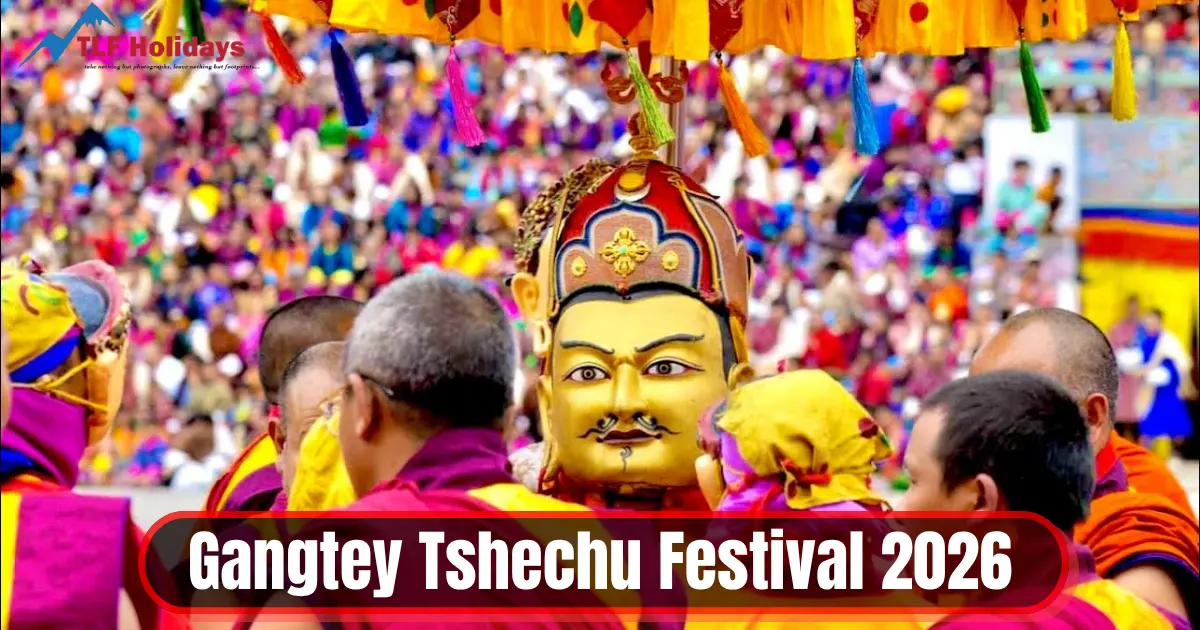
The Gangtey Tshechu is a three-day religious festival dedicated to Guru Rinpoche and follows the traditions of the Peling (Nyingmapa) school of Buddhism the oldest and one of the most spiritually rich Buddhist traditions in the world. During these three sacred days, monks from Gangtey Monastery, adorned in elaborate painted masks and richly embroidered silk robes, perform a series of sacred masked dances known as Cham. These performances are not mere theatrical spectacles; they are deeply meaningful religious rituals believed to bring divine blessings, cleanse negative karma, and guide devotees toward spiritual awakening.
Unlike larger, more commercialised festivals in Bhutan’s urban centres, the Gangtey Tshechu retains an intimate, community-centred atmosphere. The festival is not only a religious observance but also a major social occasion for the remote communities of Phobjikha Valley, who gather in their finest traditional attire, exchange blessings, share meals, and celebrate their shared cultural identity. For international visitors, this creates an unparalleled opportunity to witness authentic Bhutanese culture in one of its most natural and undiluted forms.
The Sacred Setting — Gangtey Monastery and Phobjikha Valley
Gangtey Goenpa Monastery: A Historical Marvel
Gangtey Goenpa Monastery, also spelled Gangteng Monastery, is far more than a festival venue it is a living, breathing centre of Bhutanese Buddhism with a history spanning over four centuries. The monastery was founded in 1613 by Gyalse Pema Thinley (Rigdzin Pema Trinley), the grandson and spiritual reincarnation of the great Bhutanese saint and “treasure revealer” (Terton) Pema Lingpa, who had prophesied in the 15th century that one of his descendants would build a monastery on the Gangtey ridge and make it a great seat of dharma.
Pema Lingpa himself, born in 1450 and considered an incarnation of Guru Rinpoche, had visited the Phobjikha Valley and, upon witnessing the sacred mountains surrounding the broad glacial valley, foretold this destiny. When Gyalse Pema Thinley fulfilled this prophecy in 1613, he established not just a monastery but a spiritual lineage that continues to this day. The current abbot is the ninth reincarnation of the Gangtey Tulku, Kunzang Pema Namgyal, and the monastery continues to serve as one of the two principal centres of the Nyingmapa school of Buddhism in Bhutan.
Over the centuries, the monastery underwent several expansions and renovations. The second Tulku, Tenzin Legpa Dondrup (1645–1726), significantly enlarged the structure, rebuilding it to resemble a dzong. The most recent and comprehensive restoration was undertaken between 2000 and 2008, carefully preserving the original aura and grandeur of the monastery while reinforcing its traditional architecture. This eight-year project was supported by the Royal Government of Bhutan and used locally crafted materials, resulting in the addition of 104 intricately carved pillars by skilled local artisans.
Phobjikha Valley — The Valley of the Cranes
Phobjikha Valley is no ordinary setting. Situated at an altitude of approximately 3,000 metres (9,800 feet), this broad, U-shaped glacial valley is one of the most ecologically and culturally significant landscapes in Bhutan. Protected within the Black Mountain National Park, Phobjikha Valley has been designated a Ramsar Wetland Site (since May 2, 2014) due to its exceptional biodiversity, which includes 13 globally threatened species in addition to its most celebrated residents the rare black-necked cranes (Grus nigricollis).
Every year, typically in the last week of October and early November, hundreds of these endangered birds migrate from the Tibetan Plateau to the warm marshy grasslands of Phobjikha Valley to spend the winter. According to a deeply cherished local legend, the black-necked cranes circle the Gangtey Monastery three times upon arrival and again upon departure as if paying homage to the sacred site. For the Bhutanese people, these cranes are considered heavenly beings whose presence blesses the entire valley.
While the cranes arrive in November (after the Gangtey Tshechu), the valley in late September during the festival is golden with ripening grasses, draped in wisps of morning mist, and surrounded by the russet hues of early autumn. The two rivers Nake Chhu and Phag Chhu meander gently across the valley floor, and the traditional Bhutanese farmhouses of the Phobjikha and Gangtey gewogs dot the landscape, creating one of the most photogenic and soul-stirring environments in all of Asia. Many travellers also stop at the iconic Dochula Pass (elevation 3,100 m) on their way to the valley, where 108 memorial chortens and panoramic Himalayan views make for a breathtaking interlude.
Gangtey Tshechu Festival 2026 Dates and Schedule
The Gangtey Tshechu Festival 2026 dates are confirmed as 24th to 26th September 2026. According to the Bhutanese lunar calendar, this corresponds to the 13th, 14th, and 15th days of the 8th lunar month a period of heightened spiritual significance and auspiciousness in the Buddhist calendar. The festival is held in the expansive courtyard of Gangtey Goenpa Monastery, providing a majestic natural amphitheatre framed by forested hillsides and open skies.
| Day | Date | Key Performances & Highlights |
| Day 1 | 24 September 2026 | Opening ceremonies, Dance of the Black Hats (Shana Cham), Dance of the Terrifying Deities (Tungam Cham), community prayers and offerings |
| Day 2 | 25 September 2026 | Dance of the Eight Manifestations of Guru Rinpoche (Guru Tshengye Cham), folk dances by local community, traditional music performances, blessing ceremonies |
| Day 3 | 26 September 2026 | Final sacred dances, unveiling of the sacred Thongdrel (giant silk thangka) at dawn, Ngedup Langwa blessing ceremony (spiritual wisdom and power), closing rituals |
Importantly, the timing of the Gangtey Tshechu places it immediately after the Thimphu Tshechu (21–23 September 2026), creating a rare opportunity for travellers to attend both the largest and the most intimate of Bhutan’s major festivals within a single week-long journey. This combination is often considered the “Golden Week” of Bhutanese festival tourism.
The Sacred Masked Dances (Cham) — A Spiritual Performance
The centrepiece of the Gangtey Tshechu is undoubtedly the
Cham — sacred masked dances performed by trained monks from Gangtey Monastery. Each Cham performance carries profound religious symbolism rooted in Vajrayana Buddhist philosophy, and the dances collectively serve three primary spiritual purposes: to impart moral teachings, to protect devotees from evil spirits, and to celebrate the victory of Buddhism and the enlightened qualities of Guru Rinpoche.
Watching the Cham is not simply an aesthetic experience but a rite of spiritual merit. Bhutanese Buddhists believe that merely witnessing these sacred dances, performed by devoted monks acting as vessels of enlightened energy, can purify negative karma accumulated over multiple lifetimes and bring the observer closer to liberation.
| Dance Name | Local Name | Spiritual Significance |
| Dance of the Black Hats | Shana Cham | Purifies the environment; prepares the sacred space for blessings |
| Dance of the Wrathful Deities | Tungam Cham | Subdues negativity; transforms ignorance into wisdom |
| Eight Manifestations of Guru Rinpoche | Guru Tshengye Cham | Re-enacts divine forms of Guru Rinpoche; represents paths to enlightenment |
| Dance with Moral Stories | Various Cham | Teaches Buddhist moral principles; depicts triumph of good over evil |
| Dance of Protection | Protective Cham | Shields devotees from destructive spirits; brings luck and prosperity |
The Thongdrel Revelation
One of the most anticipated and moving moments of the entire Gangtey Tshechu is the unveiling of the Thongdrel a colossal, intricately embroidered silk thangka (religious scroll painting) depicting Guru Rinpoche. The Thongdrel is displayed in the pre-dawn hours of the final festival day and is taken down before the sun’s rays touch it. This is significant: it is believed that the mere sight of the Thongdrel can cleanse one’s sins and negative karma, and those who witness it are considered supremely blessed. For many Bhutanese pilgrims who travel long distances for this moment, the Thongdrel revelation is the spiritual pinnacle of their year.
The Ngedup Langwa Blessing
The festival concludes with a powerful ceremony called Ngedup Langwa a special blessing for spiritual wisdom and power. Devotees queue for hours to receive this blessing from the resident lamas, believing it will grant them prosperity, good health, and spiritual progress. For international visitors, this is a rare and genuinely moving opportunity to participate (respectfully and with appropriate humility) in a living religious tradition that has continued unchanged for centuries.
Why the Gangtey Tshechu Stands Apart
There are dozens of tshechu festivals held across Bhutan each year, from the grand Paro Tshechu to the internationally famous Thimphu Tshechu. So what makes the Gangtey Tshechu Festival uniquely compelling? Several factors distinguish it from all other festivals in the Bhutanese calendar:
Intimacy and Authenticity: Unlike the Thimphu Tshechu, which attracts thousands of tourists annually and is held in an urban setting, the Gangtey Tshechu remains refreshingly uncrowded and deeply authentic. The small scale of the festival allows for genuine human connection with local Bhutanese communities you will find yourself seated alongside farming families, monks, and village elders, all sharing in the same sacred experience.
Peling Tradition: The dances performed at Gangtey follow the Peling tradition of the Nyingmapa school one of the oldest and most mystically complex Buddhist lineages. This gives the Gangtey Tshechu a distinct spiritual flavour compared to festivals following the Drukpa Kagyu tradition that predominates in western Bhutan.
Natural Setting: No other major festival in Bhutan is held against such a spectacular natural backdrop. The combination of golden autumn meadows, forested hills, the soaring Himalayan peaks visible on clear days, and the spiritual presence of the monastery creates an atmosphere of profound peace and wonder that is genuinely incomparable.
Synergy with Wildlife: The late September timing of the festival means that while the black-necked cranes have not yet arrived (they come in late October), the valley is alive with migratory birds, wildflowers, and the last warm light of the pre-winter season. Visitors who stay a few extra days can explore the Gangtey Nature Trail and the Black-Necked Crane Information Centre to deepen their understanding of the valley’s exceptional ecological heritage.
Sacred Legacy: With over 400 years of uninterrupted celebration, the Gangtey Tshechu carries a weight of living history that is genuinely humbling. When you stand in the monastery courtyard and watch the monks perform the same dances that their predecessors have performed since the early 17th century, you are participating in a tradition that connects the present to a deeply sacred past. Those interested in the full sweep of this heritage should explore the rich History of Bhutan Tourism and cultural evolution that has allowed these traditions to be shared with the world while remaining authentically preserved.
How to Plan Your Visit to the Gangtey Tshechu Festival 2026
Getting to Phobjikha Valley
All international visitors to Bhutan arrive at Paro International Airport currently the only international airport in the country. From Paro, the journey to Gangtey Valley involves driving through some of Bhutan’s most scenic landscapes:
Paro → Thimphu: Approximately 54–56 km, about 1 hour’s drive through the Paro River valley
Thimphu → Punakha: Approximately 76 km, about 2.5–3 hours, crossing the Dochu La Pass (3,100 m), which offers spectacular views of the Eastern Himalayan range on clear days
Punakha → Gangtey: Approximately 75 km, about 2 hours, winding through the Wangdue Phodrang district and climbing to the Gangtey valley rim
The full journey from Paro to Gangtey takes a full day with sightseeing stops, but the extraordinary diversity of landscapes encountered — subtropical river valleys, dense rhododendron forests, high mountain passes, and finally the dramatic reveal of the open Phobjikha Valley — makes every kilometre worthwhile.
Bhutan Visa and Sustainable Development Fee (SDF)
To visit Bhutan, all international tourists (excluding citizens of India, Bangladesh, and Maldives) must obtain a Bhutan Visa (USD 40 per person) and pay the Sustainable Development Fee (SDF) of USD 100 per person per night. These fees must be arranged through a licensed Bhutanese tour operator before arrival. The SDF funds Bhutan’s extraordinary public services, including free healthcare and education, and underpins the country’s Gross National Happiness philosophy of prioritising well-being over GDP.
Recommended Itinerary: 7–9 Days
A Bhutan Cultural Tour Package of 7 days can comfortably include the Gangtey Tshechu while also covering Bhutan’s most iconic sights. A suggested outline for a 9-day itinerary centred on the festival:
Days 1–2: Arrive Paro → Thimphu sightseeing (Buddha Dordenma Statue, National Memorial Chorten, Tashichho Dzong, Changlimithang archery ground)
Day 3: Thimphu → Punakha (crossing Dochu La Pass, Punakha Dzong, Chimi Lhakhang)
Day 4: Punakha → Gangtey (arrive afternoon, explore valley)
Days 5–6: Attend Gangtey Tshechu Festival 2026 (24–26 September); Gangtey Nature Trail hike
Day 7: Gangtey → Thimphu sightseeing
Day 8: Thimphu → Paro; hike to Tiger’s Nest Monastery (Paro Taktsang)
Day 9: Departure from Paro International Airport
Practical Travel Information Table
| Category | Details for Travellers |
| Best Time to Arrive | 2–3 days before the festival (22–23 September 2026) to acclimatise and explore the valley |
| Accommodation | Limited lodges in Phobjikha Valley – book at least 3–4 months in advance. Options include eco-lodges, guesthouses, and boutique hotels |
| Climate (Sept) | Cool and crisp; daytime 12–18°C, mornings as low as 5–08°C. Pack warm layers and waterproof jacket |
| How to Reach | Fly into Paro International Airport. Drive to Thimphu (1 hr), then Punakha (2.5 hrs), then Gangtey (2 hrs). Total road journey approx. 5–6 hrs from Paro |
| Visa | Bhutan Visa (USD 40 per person); obtainable through a licensed Bhutanese tour operator only |
| Photography | Permitted in the courtyard. Do not interrupt ritual performances or photograph restricted monastery interiors without permission |
| Dress Code | Dress modestly and respectfully. Kira (for women) or traditional dress is welcomed but not mandatory for tourists |
| Combine With | Thimphu Tshechu (21–23 Sept 2026), Punakha Dzong, Tiger’s Nest Monastery, Black-Necked Crane Festival (Nov 2026) |
What to Experience Beyond the Festival
Arriving a day or two before the festival and staying an extra day after gives you time to explore the extraordinary offerings of the Phobjikha Valley and its surrounds:
Gangtey Nature Trail: A scenic 5–6 km walking trail that starts near the monastery, winds through traditional villages of the Phobjikha and Gangtey gewogs, passes through dense pine forests, and descends to the valley floor. The trail takes approximately 3 hours and provides intimate glimpses of rural Bhutanese life farmhouses with wooden facades, yak herders, and fields of buckwheat and potatoes.
Black-Necked Crane Information Centre: Located on the edge of the valley marshland, this visitor centre offers high-powered telescopes, interactive displays, and educational exhibits on the ecology of the Phobjikha Valley and the migratory habits of the black-necked cranes. Even in September, before the cranes arrive, the centre provides excellent context for understanding the valley’s ecological significance.
Kumbu Lhakhang: A historic temple approximately one hour’s walk from Gangtey village, built by Tibetan Lama Tshenden Dawa in the 17th century. The walk itself is enchanting, leading through forest and farmland.
Gogona Valley: A short drive from Gangtey village, this secluded side valley offers spectacular scenery and opportunities for bird-watching in a completely undisturbed environment.
Traditional Hot Stone Bath: Many lodges in the Phobjikha Valley offer the traditional Bhutanese Dotsho (hot stone bath), a therapeutic practice using river-heated stones to warm naturally collected water infused with medicinal herbs. After days of walking and celebration, this is an exquisitely restorative experience.
Thimphu Tshechu 2027 — Looking Ahead
For those who cannot make the 2026 dates or who wish to plan future journeys, it is worth noting that Thimphu Tshechu 2027 will be held in September 2027 (exact lunar calendar dates to be confirmed in due course). The Thimphu Tshechu is Bhutan’s largest and most internationally attended festival, held at the spectacular Tashichho Dzong in the heart of the capital. Like the Gangtey Tshechu, it features sacred Cham dances, the dawn unveiling of a magnificent Thongdrel, and a vibrant social atmosphere that draws Bhutanese people from across the country. Combining a future visit with the Gangtey Tshechu as many seasoned Bhutan travellers choose to do creates a deeply enriching dual-festival itinerary.
Travel Tips for the Gangtey Tshechu Festival 2026
Book Early: Accommodation in Phobjikha Valley is extremely limited. Lodges and boutique hotels fill up months in advance for the festival dates. Aim to confirm your accommodation by June 2026 at the latest.
Hire a Local Guide: The Cham performances are rich in symbolism that only makes sense with context. A knowledgeable local guide will help you understand what you are witnessing, dramatically deepening the experience.
Dress Respectfully: The festival is a sacred religious event. Dress modestly, remove footwear when entering monastery interiors, and avoid walking in front of actively worshipping devotees.
Arrive Before Sunrise on Day 3: The Thongdrel unveiling happens at dawn and lasts only a few hours before the silk thangka is carefully rolled and stored. Missing it would mean missing one of the most extraordinary visual and spiritual experiences the festival offers.
Acclimatise: At 3,000 metres, some visitors experience mild altitude discomfort in the first day or two. Arrive a day early, drink plenty of water, and avoid strenuous activity on your first day in the valley.
Respect Wildlife and Conservation: Phobjikha Valley is a protected Ramsar wetland. Stay on marked trails, do not litter, and support the valley’s conservation ethos by choosing eco-friendly accommodations.
Why Book with TLF Holidays Bhutan
Planning a culturally immersive festival journey to a destination as unique and tightly regulated as Bhutan requires expert guidance. TLF Holidays Bhutan is a specialist Bhutan travel company with deep experience in curating personalised festival tours that combine cultural depth, logistical precision, and authentic local connections. From securing pre-booked festival-period accommodation in Phobjikha Valley to arranging seamless visa processing, sustainable development fee payments, airport transfers, and expert English-speaking guides, TLF Holidays Bhutan handles every detail so you can be fully present for the magic of the Gangtey Tshechu Festival 2026.
Their team’s intimate knowledge of the Bhutanese festival calendar including the optimal combination of the Gangtey Tshechu with the Thimphu Tshechu and other key cultural events ensures that your journey is not just a holiday but a meaningful encounter with one of the world’s last truly intact living Buddhist cultures.
Conclusion
The Gangtey Tshechu Festival 2026 to be held on 24th to 26th September 2026 at Gangtey Goenpa Monastery in Phobjikha Valley represents one of the finest opportunities in the travel calendar to experience Bhutan at its most authentic, spiritually resonant, and visually breathtaking. From the ancient masked Cham dances performed by robed monks carrying forward a 400-year-old tradition, to the sacred Thongdrel unveiling at dawn, to the golden September light playing across one of the Himalaya’s most beautiful glacial valleys, this festival is a profoundly moving and genuinely transformative experience.
It sits perfectly alongside the Thimphu Tshechu (21–23 September 2026) for travellers who wish to experience Bhutan’s festival culture in all its variety from the grandeur of the capital’s celebration to the intimate community spirit of the mountain valley. Whether you are drawn by spiritual curiosity, cultural fascination, photographic ambition, or simply the desire to experience something genuinely extraordinary, the Gangtey Tshechu Festival 2026 will exceed your every expectation. Begin planning your journey today. Contact TLF Holidays Bhutan to secure your place in Phobjikha Valley before accommodation fills up for this extraordinary event.
FAQs
Q1. What are the Gangtey Tshechu Festival 2026 dates?
The Gangtey Tshechu Festival 2026 is scheduled from 24th to 26th September 2026, corresponding to the 13th–15th day of the 8th Bhutanese lunar month.
Q2. Where is the Gangtey Tshechu Festival held?
The festival is held in the courtyard of Gangtey Goenpa Monastery, located in Phobjikha Valley, Wangdue Phodrang District, Bhutan, at an altitude of approximately 3,000 metres.
Q3. How many days does the Gangtey Tshechu last?
The Gangtey Tshechu is a three-day festival, running from the morning of the first day through to the closing ceremonies and Ngedup Langwa blessing on the final day.
Q4. Can tourists attend the Gangtey Tshechu Festival?
Yes, international tourists are warmly welcome to attend the Gangtey Tshechu; however, all visitors must enter Bhutan through a licensed tour operator and pay the applicable SDF (USD 100/night) and visa fee (USD 40). An entry fee of USD 12.50 applies specifically for the festival.
Q5. What should I wear to the Gangtey Tshechu Festival?
Dress modestly and respectfully in warm layers, as Phobjikha Valley is cool in September; comfortable walking shoes are essential, and a waterproof jacket is recommended for early mornings.
Q6. Will I see black-necked cranes during the Gangtey Tshechu in September?
No — the black-necked cranes do not arrive in Phobjikha Valley until the last week of October or early November; to see the cranes, visit the Black-Necked Crane Festival on 11th November 2026.
Q7. Can I combine the Gangtey Tshechu with the Thimphu Tshechu?
Yes — the Thimphu Tshechu runs from 21–23 September 2026 and the Gangtey Tshechu starts on 24 September 2026, making them perfectly sequential for a combined festival itinerary.
Q8. What is the Thongdrel and why is it important?
The Thongdrel is a gigantic sacred silk thangka (painted scroll) depicting Guru Rinpoche, unveiled only at dawn on the final festival day; Bhutanese Buddhists believe that seeing it can cleanse one’s sins and bring great spiritual merit.
Q9. How far in advance should I book for the Gangtey Tshechu Festival 2026?
Given the very limited accommodation in Phobjikha Valley and high festival-season demand, booking at least 3–4 months in advance (ideally by June 2026) through a licensed operator such as TLF Holidays Bhutan is strongly recommended.


Comments (48)
Elinor844,
04 April, 2026https://shorturl.fm/wF1tk
Fiona3261,
04 April, 2026https://shorturl.fm/2OG1F
Delaney4031,
04 April, 2026https://shorturl.fm/tU31R
Haven3496,
04 April, 2026https://shorturl.fm/ybGqL
Clifton3410,
04 April, 2026https://shorturl.fm/HTxvd
Nellie1412,
04 April, 2026https://shorturl.fm/WQ1xi
Ian1690,
04 April, 2026https://shorturl.fm/LQqTh
Kaden3665,
04 April, 2026https://shorturl.fm/l8iI1
Kyra1196,
04 April, 2026https://shorturl.fm/nPwQf
Emmett3603,
04 April, 2026https://shorturl.fm/ydKwA
Kane3839,
04 April, 2026https://shorturl.fm/DQtUs
Darren3362,
04 April, 2026https://shorturl.fm/Kzd9f
Felix1530,
04 April, 2026https://shorturl.fm/ha2RT
Alexa4375,
04 April, 2026https://shorturl.fm/K2KWy
Oliver212,
04 April, 2026https://shorturl.fm/3LRYU
Clementine1380,
04 April, 2026https://shorturl.fm/HEnVZ
Dakota2627,
04 April, 2026https://shorturl.fm/UiH88
Gavin2388,
04 April, 2026https://shorturl.fm/u3S8R
Dorian4093,
04 April, 2026https://shorturl.fm/USOLw
Gloria1675,
04 April, 2026https://shorturl.fm/Vvkoi
Joel2975,
04 April, 2026https://shorturl.fm/MwoCS
Clifton4071,
04 April, 2026https://shorturl.fm/9pa95
Mariah4519,
04 April, 2026https://shorturl.fm/Nj6Wh
Josephine607,
04 April, 2026https://shorturl.fm/zNww3
Carey4862,
04 April, 2026https://shorturl.fm/0Olp1
Leila3244,
05 May, 2026https://shorturl.fm/5HXXN
Marilyn2098,
05 May, 2026https://shorturl.fm/9S3Mv
Andre2796,
05 May, 2026https://shorturl.fm/L65WG
Levi4689,
05 May, 2026https://shorturl.fm/WJKnd
Mila1019,
05 May, 2026https://shorturl.fm/YC9eH
Andre1871,
05 May, 2026https://shorturl.fm/DLtke
Austin4818,
05 May, 2026https://shorturl.fm/xUKp3
Dawn3101,
05 May, 2026https://shorturl.fm/vQCrc
Virginia3666,
05 May, 2026https://shorturl.fm/wZMLn
Celia1536,
05 May, 2026https://shorturl.fm/ssH31
Ruby4494,
05 May, 2026https://shorturl.fm/hzESd
Elise2765,
05 May, 2026https://shorturl.fm/RqE43
Emmanuel2231,
05 May, 2026https://shorturl.fm/cukQV
Adrian2047,
07 July, 2026https://shorturl.fm/orprJ
Vera4495,
07 July, 2026https://shorturl.fm/s9vSi
Drew1861,
07 July, 2026https://shorturl.fm/PXH22
Madison4046,
07 July, 2026https://shorturl.fm/sgFtp
Aubrey2943,
07 July, 2026https://shorturl.fm/S3RY5
Levi2961,
08 August, 2026https://shorturl.fm/cdyID
Hudson1855,
08 August, 2026https://shorturl.fm/bkGcE
pkbaij999,
09 September, 2026I’ve been using this platform for a while now and the experience is just smooth. Definitely one of the best choices for gaming. Check out pkbaij999 for more info.
idhulk123,
09 September, 2026Fast registration and even faster gameplay. I love the variety of options available on this platform. It’s very refreshing. Visit idhulk123
phskycasinologinph,
09 September, 2026The login process is quick and the security feels solid. I love the overall aesthetic of the site. Keep up the great work phskycasinologinph!