



- 580 Views
- 19 Min Read
- (14) Comments
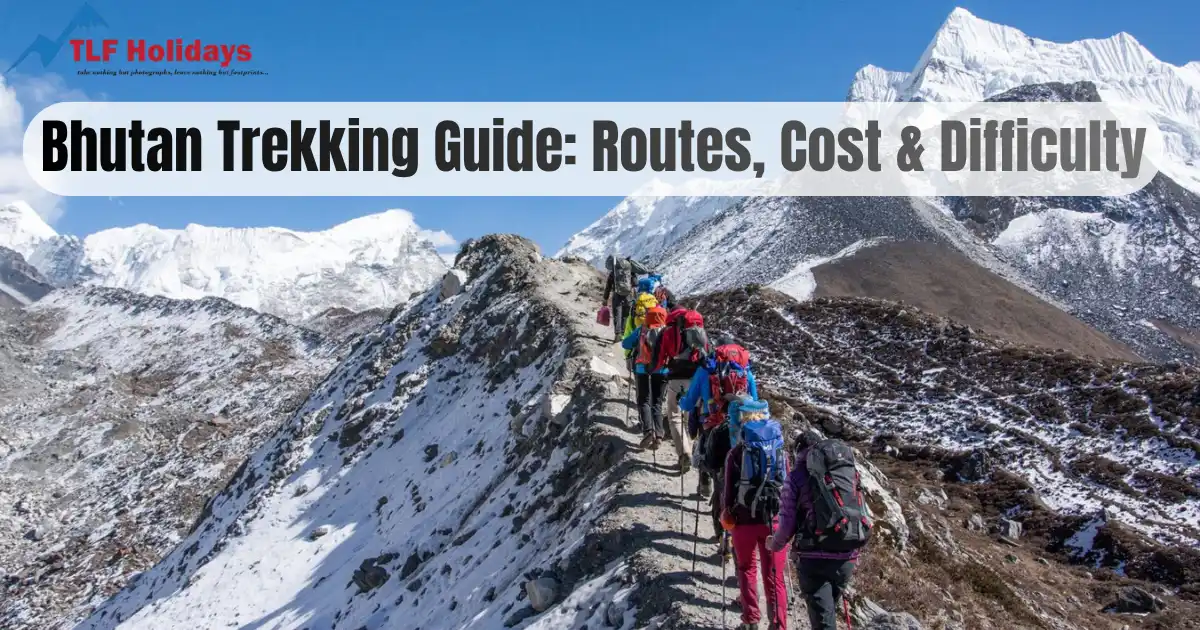
Nestled deep in the eastern Himalayas, the Kingdom of Bhutan is one of the world’s last true trekking frontiers. With ancient monasteries clinging to cliff faces, pristine alpine meadows untouched by mass tourism, and a philosophy rooted in Gross National Happiness, Bhutan offers a trekking experience that is entirely in a class of its own. Whether you are a seasoned mountaineer or a first-time high-altitude hiker, this Bhutan Trekking Guide will walk you through everything you need to know from the best routes and realistic costs to packing tips and the ideal time to visit.
Bhutan’s government has always prioritized high-value, low-impact tourism. This means the trails are never overcrowded, the environment is astonishingly pristine, and your trek contributes directly to conservation and local communities. More than 72% of the country remains under forest cover, and over 51% is designated as protected areas making it one of the most biodiverse trekking destinations on Earth.
If you are comparing Himalayan destinations and wondering about Nepal or Bhutan which is better for your next adventure, the honest answer depends on what you seek. Nepal offers more variety and lower costs, but Bhutan offers exclusivity, cultural immersion, and pristine wilderness that Nepal’s busier trails simply cannot match.
Bhutan Trekking Routes at a Glance
| Trek Name | Duration | Max Altitude | Difficulty | Best Season |
| Druk Path Trek | 5–6 Days | 4,210 m | Moderate | Mar–May, Sep–Nov |
| Snowman Trek | 24–30 Days | 5,320 m | Extreme | Sep–Oct |
| Jhomolhari Trek | 8–12 Days | 4,930 m | Strenuous | Mar–May, Sep–Nov |
| Bumthang Cultural Trek | 3–4 Days | 3,100 m | Easy–Moderate | Year Round |
| Laya–Gasa Trek | 11–14 Days | 4,700 m | Strenuous | Oct–Nov |
| Rodung La Trek | 8–10 Days | 4,160 m | Moderate–Hard | Apr–Jun, Sep–Nov |
| Dagala Thousand Lakes | 5–6 Days | 4,520 m | Moderate | Sep–Oct |
| Nabji Korphu Trek | 9–11 Days | 1,800 m | Easy | Nov–Mar |
The Best Trekking Routes in Bhutan: Detailed Breakdown
1. Druk Path Trek — The Classic Bhutan Trekking Experience
The Druk Path Trek is the most popular route in our Bhutan Trekking Guide itinerary for first-time visitors. Connecting the historic towns of Paro and Thimphu, this 65 km trail passes through stunning highland meadows, rhododendron forests, and a series of serene glacial lakes including Jimilang Tsho and Simkota Tsho. You will also encounter ruined dzongs (fortresses) and pristine yak pastures on this five to six day journey.
The trail’s highest point at 4,210 metres makes it a great introduction to high-altitude trekking without requiring technical climbing skills. Acclimatization is important, however, and trekkers should plan a rest day in Paro or Thimphu before starting. The views of the Jhomolhari and Jichu Drake peaks are simply breathtaking on clear mornings.
- Distance: Approximately 65 km
- Duration: 5–6 days
- Highest Point: 4,210 m (Phume La Pass)
- Difficulty: Moderate
- Start/End: Paro to Thimphu
2. Snowman Trek — The World’s Toughest Trek
No Bhutan Trekking Guide would be complete without mentioning the legendary Snowman Trek. Widely regarded as one of the most challenging treks on the planet, this epic 380 km journey crosses eleven high-altitude passes, many above 5,000 metres, and takes anywhere from 24 to 30 days to complete. The route passes through remote northern Bhutan, offering encounters with the semi-nomadic Layap people and jaw-dropping Himalayan scenery.
The Snowman Trek should only be attempted by very experienced trekkers who are accustomed to extreme altitude, long distances, and rapidly changing mountain weather. The success rate for completing the full route is reportedly less than 50%, due to unpredictable weather, high passes that may remain snowbound, and the sheer physical endurance required. Despite this, it remains a bucket-list objective for hardcore adventure seekers worldwide.
- Distance: Approximately 380 km
- Duration: 24–30 days
- Highest Point: 5,320 m (Rinchen Zoe La Pass)
- Difficulty: Extreme
- Best Season: Late September to mid-October
3. Jhomolhari Trek — Glaciers, Passes & Remote Villages
The Jhomolhari Trek is perhaps the most iconic route in all Bhutan trekking packages. Beginning in Paro and heading north toward the Tibetan border, the trail offers unrivalled views of the sacred Jhomolhari peak (7,326 m), which dominates the landscape from the remote Jangothang base camp. This area is one of the few places in the world where snow leopards have been spotted in the wild.
The trek can be done as a loop (Jhomolhari Trek 2) or as an out-and-back route (Jhomolhari Trek 1). The classic version reaches Lingzhi village before looping back via the Thombu La and Yeli La passes. Trekkers regularly describe this as a life-changing journey the combination of high-altitude wilderness, ancient villages, and direct views of Himalayan giants is simply unparalleled.
- Distance: Approximately 148 km (full loop)
- Duration: 8–12 days
- Highest Point: 4,930 m (Nyile La Pass)
- Difficulty: Strenuous
- Wildlife: Snow leopards, blue sheep, Himalayan wolves
4. Bumthang Cultural Trek — For Those Seeking History & Spirituality
If you want a gentler introduction to trekking in Bhutan, the Bumthang Cultural Trek is the ideal choice. Set in the central highlands of Bumthang often described as Bhutan’s spiritual heartland this 3 to 4 day trek winds through ancient Buddhist monasteries, traditional farmhouses, and apple orchards. The altitude remains below 3,100 metres, making it accessible for almost all fitness levels.
Key highlights include visits to Jakar Dzong, Jambay Lhakhang (one of Bhutan’s oldest temples, said to be over 1,400 years old), and Membartsho the sacred ‘Burning Lake’ where the treasure discoverer Pema Lingpa reportedly found hidden treasures. This trek is included in many Bhutan trekking packages as a cultural extension of the main Paro-Thimphu circuit.
5. Laya–Gasa Trek — The Remote Northern Wilderness
Extending the Jhomolhari Trek, the Laya–Gasa route continues north to the remote village of Laya, home to the fascinating Layap people who have retained a distinct culture, language, and dress for centuries. The women of Laya are famous for their distinctive conical bamboo hats. The trek eventually descends to Gasa famous for its hot springs where trekkers can soak tired muscles before continuing onward. This 11 to 14 day trek is one of the finest in our Bhutan Trekking Guide for those seeking genuine cultural encounters alongside high-altitude adventure. The trail crosses several passes above 4,500 metres and requires solid physical preparation.
Bhutan Trekking Guide Cost: What to Expect
One of the most frequently asked questions we receive at TLF Holidays Bhutan is: how much does trekking in Bhutan actually cost? The answer involves understanding Bhutan’s unique tourism pricing structure. Unlike most countries, Bhutan charges a mandatory Sustainable Development Fee (SDF), which was revised in 2023 and again partially adjusted in 2024. Understanding these fees upfront is essential to budget planning.
Many travellers wonder Is Bhutan Expensive compared to other Himalayan destinations. The answer is yes but the costs cover almost everything, including accommodation, meals, a licensed guide, transport, and the SDF itself. When you factor in what is included, the value proposition becomes much clearer.
Bhutan Trekking Guide Cost Breakdown (Per Person)
| Cost Component | Budget Range (USD) | Notes |
| Sustainable Development Fee | $100/day | Mandatory for all tourists (revised 2024) |
| Basic Trek Package (Guides, Cook, Horses) | $80–$150/day | Per person; varies by group size |
| Camping & Equipment Rental | $20–$40/day | Tents, sleeping bags, kitchen gear |
| Internal Flights (e.g., Paro–Bumthang) | $200–$300/trip | Optional; saves travel time |
| Visa Fee | $40 one-time | Processed through licensed operators only |
| Personal Gear & Porter Tips | $50–$100 total | Discretionary |
| Total Estimated Cost (7-day trek) | $2,000–$3,500 | Varies by group size and season |
| Total Estimated Cost (14-day trek) | $4,000–$6,500 | Including SDF & full services |
It is important to note that all Bhutan trekking packages must be arranged through a government-licensed tour operator. Independent trekking as is common in Nepal is not permitted in Bhutan. This policy ensures that every trekker has professional support, contributing to both safety and the local economy. The all-inclusive nature of Bhutan trekking packages means there are very few hidden costs once you are on the trail.
For travellers from Southeast Asia, Bhutan Tour Packages from Malaysia are increasingly popular, with several operators offering convenient multi-city itineraries via Kuala Lumpur. These packages typically combine Paro, Thimphu, and Punakha sightseeing with a 4 to 7 day trek, making them excellent value for first-time Bhutan visitors.
Understanding Trek Difficulty Levels in Bhutan
Bhutan’s trekking routes span a wide spectrum of difficulty, from gentle valley walks to gruelling high-altitude crossings. Our Bhutan Trekking Guide categorizes these into five levels to help you choose the most suitable route for your fitness level and experience.
Trek Difficulty Classification
| Difficulty Level | Daily Distance | Max Altitude | Fitness Required | Recommended For |
| Easy | 8–12 km/day | Below 2,500 m | Basic walking fitness | Beginners, families, seniors |
| Moderate | 12–16 km/day | 2,500–4,200 m | Regular cardio exercise | Occasional hikers |
| Strenuous | 16–20 km/day | 4,200–5,000 m | High endurance + altitude exp. | Experienced trekkers |
| Extreme | 20+ km/day | 5,000 m+ | Elite fitness + mountaineering | Expert alpinists only |
Altitude Sickness: What Every Trekker Must Know
Acute Mountain Sickness (AMS) is a genuine concern on most Bhutan treks, particularly routes that ascend above 3,500 metres. Symptoms include headache, nausea, dizziness, fatigue, and loss of appetite. In severe cases, AMS can progress to High Altitude Pulmonary Edema (HAPE) or High Altitude Cerebral Edema (HACE), both of which are life-threatening medical emergencies.
The golden rule is: never ascend faster than your body can acclimatize. Most experienced guides follow the principle of climbing high and sleeping low. For treks above 4,000 metres, it is strongly recommended to include a dedicated acclimatization day. Staying well-hydrated, avoiding alcohol in the first few days, and informing your guide immediately if you feel unwell are all essential precautions.
- Carry Diamox (acetazolamide) as a preventive measure after consulting your doctor
- Ascend no more than 300–500 metres per day above 3,000 m
- Descend immediately if severe symptoms develop — do not wait
- Ensure your trek operator has emergency evacuation protocols in place
Best Time to Visit for Bhutan Trekking
The timing of your trek significantly impacts the experience. Bhutan has four distinct seasons, each with its own character and appeal. Our Bhutan Trekking Guide recommends two primary windows as the optimal trekking seasons.
Spring (March to May) — The Rhododendron Season
Spring is arguably the most visually stunning time to trek in Bhutan. The hillsides explode in colour as hundreds of rhododendron species burst into bloom — from deep crimson to pale pink and white. Days are warm and clear, nights are cold at altitude, and the trails are at their most vibrant. This season is ideal for the Druk Path, Jhomolhari, and Bumthang treks.
Autumn (September to November) — Crystal Clear Skies
Post-monsoon autumn delivers the clearest skies and sharpest mountain views of the year. The air is washed clean by the summer rains, making this the preferred season for high-altitude treks like the Snowman Trek and the Laya–Gasa Trek. October in particular is considered the absolute peak of Bhutan’s trekking calendar, with comfortable temperatures and low precipitation.
Winter (December to February) — Quiet Trails & Low Costs
Lower altitude treks like the Nabji Korphu Trek in the subtropical Jigme Singye Wangchuck National Park are perfectly enjoyable in winter. High passes will be snowbound, but the lodges are quieter, costs may be lower, and the monasteries are beautifully atmospheric in snow. Not suitable for treks above 3,500 metres.
Monsoon (June to August) — For the Adventurous
The monsoon season brings heavy rainfall, leeches, and muddy trails but it also brings dramatically lush green landscapes and a truly off-the-beaten-path experience. A few operators offer monsoon treks for adventurous travellers willing to deal with the conditions. The Nabji Korphu and Bumthang Cultural treks are viable during this period.
Bhutan Trekking Season Guide
| Season | Months | Trail Conditions | Crowd Level | Recommended Treks |
| Spring | Mar–May | Excellent; blooming flora | Moderate | Druk Path, Jhomolhari, Bumthang |
| Monsoon | Jun–Aug | Wet; leeches; lush green | Low | Nabji Korphu, Bumthang (lower) |
| Autumn | Sep–Nov | Best visibility; dry trails | High | Snowman, Laya-Gasa, All Routes |
| Winter | Dec–Feb | Cold; high passes closed | Very Low | Nabji Korphu, Lower Bumthang |
Sample Bhutan Trekking Guide Itinerary: 8-Day Jhomolhari Trek
To give you a practical sense of what a typical Bhutan trek looks like day by day, here is a sample Bhutan Trekking Guide itinerary based on the classic Jhomolhari Trek, one of the most requested routes through TLF Holidays Bhutan.
Day 1: Arrive in Paro — Acclimatization & Orientation
Arrive at Paro International Airport (one of the most dramatic landings in the world, with the runway tucked between steep forested hillsides). Transfer to your hotel and spend the afternoon acclimatizing. Visit the Rinpung Dzong and the Paro National Museum for cultural context before the trek begins. Briefing with your guide in the evening.
Day 2: Paro to Shana (2,870 m) — 23 km, 6–7 hours
The trek begins at the Paro checkpoint, following the Paro Chhu (river) upstream. The trail passes through dense blue pine and rhododendron forests, crossing several bridges. Shana is the last permanent village before entering the Jigme Dorji National Park. Camping here offers first views of distant snow peaks.
Day 3: Shana to Soi Thangthangka (3,480 m) — 18 km, 6 hours
Today the valley narrows dramatically and the trail climbs through glacial moraines. The vegetation transitions from forest to open alpine terrain. Yak herders’ camps become more common, and on clear days, the flanks of Jhomolhari begin to appear ahead.
Day 4: Soi Thangthangka to Jangothang (4,090 m) — 18 km, 6 hours
The most celebrated day of the trek. As you round the final corner of the valley, Jhomolhari (7,326 m) presents itself in full a colossal white wall of ice and rock that dominates everything. Jangothang base camp sits in a wide, grassy meadow beside a clear glacial lake. This is one of the most dramatic high-altitude camping locations in all of Asia.
Day 5: Acclimatization Day at Jangothang
A rest and acclimatization day at Jangothang. Your guide will lead a short hike to the ruins of the ancient Jangothang Dzong above camp. This is also a prime location for wildlife watching snow leopards, Himalayan wolves, and blue sheep all inhabit this area. The evening views of Jhomolhari at sunset are extraordinary.
Day 6: Jangothang to Lingzhi (4,010 m) via Nyile La (4,870 m) — 20 km, 7–8 hours
The highest and most demanding day of the trek. The Nyile La pass at 4,870 metres offers panoramic views of dozens of Himalayan peaks including Jichu Drake, Tserim Gang, and the Tibetan plateau. Lingzhi village, with its magnificent dzong perched on a hillside, is your reward for the day’s effort.
Day 7: Lingzhi to Shodu (3,380 m) via Yeli La (4,870 m) — 22 km, 7 hours
Another high pass day the Yeli La is equally spectacular. The descent to Shodu takes you through remote herder settlements where you may be invited for butter tea. The hospitality of Bhutanese highlanders is genuinely warm and memorable.
Day 8: Shodu to Drukyel Dzong, Paro — 19 km, 5–6 hours
The final day descends steadily back to civilization, ending at the ruins of Drukyel Dzong near Paro. A vehicle meets you here for the transfer to Paro town. Celebrate with a traditional Bhutanese hot stone bath (dotsho) a perfect remedy for eight days of mountain walking.
Essential Packing List for Bhutan Trekking
Packing correctly can make or break a Bhutan trek. The key principle is layering temperatures can vary by 20–25°C between the valley floor and a high pass, often within a single day. Here is what every trekker should carry:
Clothing
- Moisture-wicking base layers (synthetic or merino wool)
- Insulating mid-layer (fleece or down jacket)
- Waterproof outer shell jacket and trousers
- Trekking trousers and shorts
- Warm hat, sun hat, and balaclava for high passes
- Gloves — both liner gloves and waterproof outer mitts
- Wool socks (minimum 4 pairs) blisters are your biggest enemy
Footwear
- Well broken-in waterproof trekking boots (ankle support is essential)
- Camp sandals or lightweight shoes for evenings
- Trekking poles highly recommended, especially for descents
Health & Safety
- Personal first aid kit with blister treatment, antiseptic, and pain relief
- Altitude medication (Diamox consult your doctor beforehand)
- Water purification tablets or a Lifestraw filter
- High-SPF sunscreen and lip balm UV radiation is intense at altitude
- Insect repellent (essential for lower altitude treks during monsoon)
Gear & Equipment
- A 40–50 litre trekking daypack (horses carry the main gear)
- Sleeping bag rated to -10°C or lower for high-altitude treks
- Headlamp with spare batteries
- Trekking poles
- Portable battery pack for phone and camera charging
- Waterproof dry bags for electronics and documents
Permits and Entry Requirements for Bhutan Trekking
Bhutan’s unique approach to tourism means all visitors including trekkers must obtain the appropriate permits and visas through a licensed Bhutanese tour operator or an international partner agency. There are no exceptions to this policy.
Tourist Visa
The Bhutan visa is stamped on arrival at Paro International Airport (or at designated land borders from India). Your licensed tour operator will submit the visa application on your behalf through the Tourism Council of Bhutan’s portal. The visa fee of USD 40 is a one-time charge, separate from the Sustainable Development Fee.
Sustainable Development Fee (SDF)
In 2023, Bhutan revised its tourism fee structure, replacing the previous daily tariff system with a Sustainable Development Fee of USD 100 per person per night. This fee directly funds free healthcare, free education, and environmental conservation across the kingdom. For longer treks like the Snowman Trek, this fee represents a significant portion of the overall cost but it is the backbone of Bhutan’s sustainable tourism model.
Restricted Area Permits
Certain northern regions of Bhutan require additional Restricted Area Permits (RAPs), obtained through your licensed operator. Areas including Laya, Lunana, and regions near the Tibetan border fall under this category. TLF Holidays Bhutan handles all permit arrangements for their trekking clients as part of the package.
Cultural Etiquette for Trekkers in Bhutan
Bhutan is a deeply Buddhist kingdom, and respecting local customs is not merely polite it is expected and important. Your guide will brief you on key protocols, but here are the most important points to bear in mind:
- Always walk clockwise around chortens (Buddhist stupas), mani walls, and prayer wheels
- Remove your shoes before entering any lhakhang (temple) or dzong
- Ask permission before photographing local people, monks, or religious ceremonies
- Dress modestly — cover shoulders and knees when entering religious sites
- Never touch or move religious objects without permission
- Keep voices low in and around temples and monasteries
- Avoid pointing feet toward altars, monks, or elder community members
- Do not collect plants, flowers, or rocks from protected areas it is illegal
Bhutanese people are among the warmest and most hospitable you will encounter anywhere in the Himalayas. Greet them with ‘Kuzu Zangpo La’ (Hello in Dzongkha) and you will invariably be met with smiles.
Choosing the Right Bhutan Trekking Operator
All trekking in Bhutan must be arranged through a government-licensed tour operator. Choosing the right operator is one of the most important decisions you will make. TLF Holidays Bhutan is a well-regarded specialist in Bhutan trekking packages, known for experienced local guides, transparent pricing, and customized Bhutan Trekking Guide itineraries that suit all fitness levels and budgets. Their in-country expertise ensures seamless permit processing, high-quality camping equipment, and professional support throughout your trek.
When evaluating any Bhutan trekking operator, look for the following:
- Government licensing and registration with the Tourism Council of Bhutan
- Experience in the specific trek you are interested in
- Transparent breakdown of what is and is not included in the price
- Emergency evacuation protocols and insurance requirements
- Client reviews and testimonials from recent trekkers
- Flexibility to customize the itinerary based on your fitness and interests
For travellers who are planning a broader Himalayan adventure, combining a Bhutan trek with a visit to Darjeeling is increasingly popular. A Darjeeling Tour Package from Bhutan allows you to extend your journey into the tea gardens and colonial hill stations of West Bengal, accessible via the Phuentsholing border crossing, adding tremendous variety to your overall Himalayan experience.
Why Bhutan Trekking is Different from Anywhere Else
After reading this comprehensive Bhutan Trekking Guide, you might ask: what really sets Bhutan apart from other great trekking destinations? The answer lies in a combination of factors that no other country on Earth can replicate.
First, there is the sheer pristineness of the environment. Bhutan’s forest cover has actually increased in recent decades the opposite trend from most Himalayan nations — because of strict environmental legislation backed by cultural values. You will trek through forests that feel genuinely ancient and undisturbed. Second, there is the cultural depth: you will walk between dzongs that have stood for 400 years, encounter monks who have never left their mountain monastery, and camp in meadows where yak herders live largely as their ancestors did centuries ago.
Third, there is the peace of the trail itself. Even on the most popular route the Druk Path you will rarely encounter more than a handful of other groups. On routes like the Laya–Gasa or the Snowman Trek, you may spend days without seeing another foreign trekker. This is an almost impossible luxury in the modern age of adventure travel.
Conclusion
This Bhutan Trekking Guide has taken you from the fundamentals of route selection and realistic Bhutan Trekking Guide cost planning through detailed day-by-day Bhutan Trekking Guide itinerary examples, essential packing advice, seasonal timing, cultural etiquette, and permit requirements. Bhutan is not the cheapest trekking destination in the Himalayas but it is arguably the most rewarding. Whether you choose the gentle cultural wanderings of the Bumthang Trek, the iconic alpine drama of the Jhomolhari route, or the once-in-a-lifetime challenge of the Snowman Trek, you will return home with memories that stay with you forever. Trekking in Bhutan is not just a physical journey it is a profound encounter with one of the world’s last truly unspoiled mountain cultures. With expert guidance from TLF Holidays Bhutan and the right preparation, your Bhutan trek will be the adventure of a lifetime.
FAQs
Q1: Do I need prior trekking experience for a Bhutan trek?
It depends on the route the Bumthang Cultural Trek requires no experience, while the Snowman Trek demands years of high-altitude mountaineering background.
Q2: Can I trek independently in Bhutan without a guide?
No, independent trekking is not permitted; all trekkers must be accompanied by a licensed Bhutanese guide arranged through an approved tour operator.
Q3: What is the Sustainable Development Fee and is it included in packages?
The SDF is a mandatory USD 100 per person per night fee; reputable operators like TLF Holidays Bhutan include it transparently in their package pricing.
Q4: What is the best trek in Bhutan for beginners?
The Druk Path Trek (5–6 days, Paro to Thimphu) is the most popular beginner-friendly option with moderate altitude and stunning scenery.
Q5: When is the best time for Bhutan trekking guide itinerary planning?
The best times are spring (March–May) for rhododendron blooms and autumn (September–November) for the clearest mountain views and stable weather.
Q6: Is trekking in Bhutan safe?
Yes, Bhutan has an excellent safety record for trekking due to mandatory licensed guides, well-established emergency protocols, and low crime rates throughout the kingdom.
Q7: How do Bhutan trekking packages compare to Nepal trekking in terms of cost?
Bhutan is significantly more expensive due to the SDF and mandatory guide policy, but costs are all-inclusive and the experience is far less crowded and more pristine.
Q8: What currency should I carry on a Bhutan trek?
The Bhutanese Ngultrum (BTN) is the local currency, pegged to the Indian Rupee; Indian Rupees are also widely accepted, while USD cash is useful for tips and emergencies.
Q9: Are there ATMs or mobile connectivity on Bhutan trekking routes?
ATMs are available in Paro and Thimphu but not on remote trails; local SIM cards (Tashi Cell or B-Mobile) offer reasonable 4G coverage in valleys but not on high passes.
Q10: What wildlife can I expect to see on Bhutan treks?
Bhutan’s trails are home to takin (the national animal), snow leopards, red pandas, Himalayan black bears, blue sheep, and over 700 species of birds.

Comments (14)
Celeste860,
04 April, 2026https://shorturl.fm/CQUSw
Scarlett4900,
04 April, 2026https://shorturl.fm/qxVlT
Bailey2428,
04 April, 2026https://shorturl.fm/NIJWC
Amalia4098,
04 April, 2026https://shorturl.fm/uZ1df
Hadley1952,
04 April, 2026https://shorturl.fm/pyKS0
Everett3228,
05 May, 2026https://shorturl.fm/6nUIB
Jason4274,
05 May, 2026https://shorturl.fm/IeskF
Marissa4831,
05 May, 2026https://shorturl.fm/suoz4
toge123login,
08 August, 2026Super easy to get started and the login process is seamless. I love how straightforward everything is here. Give toge123login a try, you wont regret it.
you7777,
08 August, 2026Everything about this site feels premium. From the customer service to the actual gaming experience, it is just flawless. you7777
bongeslotlogin,
09 September, 2026The bonuses here are actually decent compared to other sites. I had a great run last night and the withdrawal was surprisingly fast. bongeslotlogin is the way to go.
betakiapp,
09 September, 2026The app version is way better than the browser. I can place my bets on the go without any lag. Great experience overall with betakiapp
zx999game,
09 September, 2026The graphics are top notch and the gameplay is very immersive. It feels like a premium casino experience from home. Love zx999game.
kk77game,
09 September, 2026I’ve been playing here for a month and the experience has been awesome. Great community and very transparent rules. kk77game is the way to go.