



- 187 Views
- 18 Min Read
- (24) Comments
December in Bhutan is one of travel’s best-kept secrets. While the rest of the world is rushing through airports for the holidays, a quieter, more magical experience awaits you in the Eastern Himalayas — one where snow-dusted monasteries rise over empty valleys, crystal-clear skies frame snow-capped peaks, and festivals light up ancient dzong courtyards. If you’ve ever wondered whether Bhutan in winter is worth the trip, the short answer is: absolutely yes.
At TLF Holidays, we’ve been crafting unforgettable Bhutan experiences for travelers from Singapore, Malaysia, Thailand, and beyond. This guide covers everything you need to know about the best places to go in December in Bhutan — from iconic landmarks to hidden valleys, seasonal festivals to insider travel tips — so you can plan your perfect winter escape to the Land of the Thunder Dragon.
Why Visit Bhutan in December? A Month Like No Other
Most travelers flock to Bhutan in spring (March–May) and autumn (September–November). That means December is gloriously off-peak — less crowded, more authentic, and often more affordable. Here’s why December is quietly becoming one of the most rewarding months to visit:
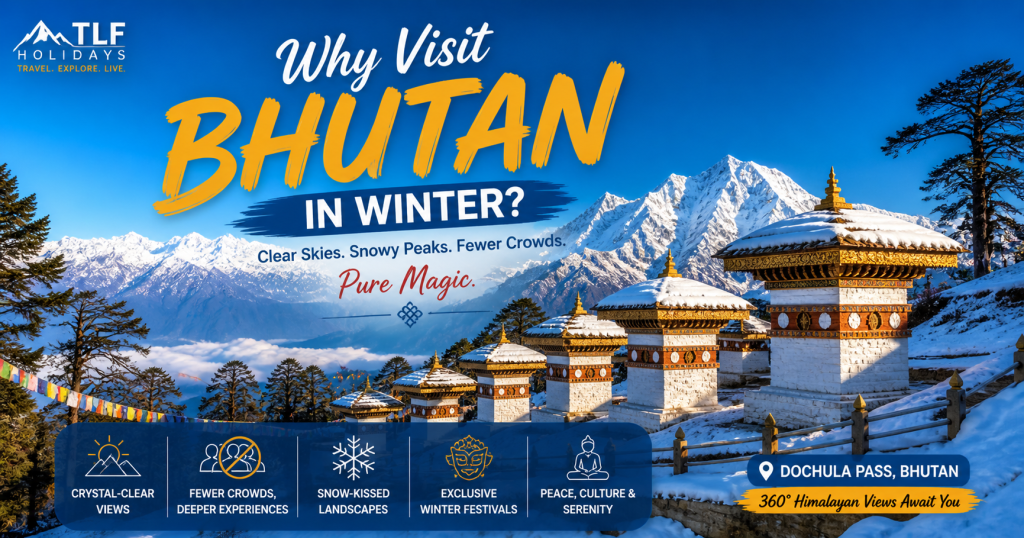
Crystal-Clear Himalayan Skies: December brings some of the year’s best visibility. The monsoon rains are long gone, leaving skies an impossibly vivid blue. From vantage points like Dochula Pass, you can see dozens of snow-capped peaks in stunning clarity — a photographer’s dream.
Fewer Crowds, Deeper Experiences: You’ll find Tiger’s Nest Monastery without long queues, monks who have time to converse, and restaurants where chefs take pride in explaining every dish. This is Bhutan without the rush.
Possibility of Snowfall: By mid-to-late December, higher-altitude areas like Bumthang, Haa Valley, and Dochula Pass see snowfall, transforming the landscape into something that feels pulled from a fairytale painting.
Exclusive December Festivals: The Druk Wangyal Tshechu at Dochula Pass (celebrated on December 13) is one of the most spectacular and least-crowded festivals in the Bhutanese calendar. You won’t find this experience any other month.
Comfortable Lower-Valley Travel: While high passes get cold, valleys like Punakha remain pleasantly warm (15–20°C during the day), making winter touring very manageable.
Bhutan December Weather: What to Expect by Region
Before diving into the best places to visit, it helps to understand what the weather looks like across Bhutan’s different zones in December.
December Temperatures Across Key Bhutan Destinations
| Destination | Altitude | Daytime Temp | Night Temp | Snow Chance | Best For |
| Punakha | 1,200m | 15–20°C | 4–7°C | Very Low | Winter warmth, dzong visit |
| Paro | 2,280m | 10–14°C | -1 to 3°C | Low-Moderate | Tiger’s Nest, photography |
| Thimphu | 2,334m | 10–12°C | -2 to -4°C | Low | Culture, museums, markets |
| Dochula Pass | 3,100m | 3–8°C | -5 to -8°C | Moderate | Panoramic views, festival |
| Bumthang | 2,600m | 4–8°C | -8 to -12°C | High (late Dec) | Snow, ancient monasteries |
| Haa Valley | 2,670m | 2–7°C | -10 to -15°C | High | Snow scenery, remoteness |
Tip: Pack thermal layers, a good down jacket, and waterproof shoes — especially if you plan to visit Bumthang or Haa. In Punakha, you can get away with lighter layers during the day.
Top Places to Visit in Bhutan in December
1. Paro – Gateway to Bhutan’s Soul
Paro is where your Bhutan adventure almost always begins — it’s home to the country’s only international airport, perched in a dramatic valley surrounded by pine forests and ancient fortresses. In December, Paro takes on a serene, frost-touched beauty that feels entirely its own.
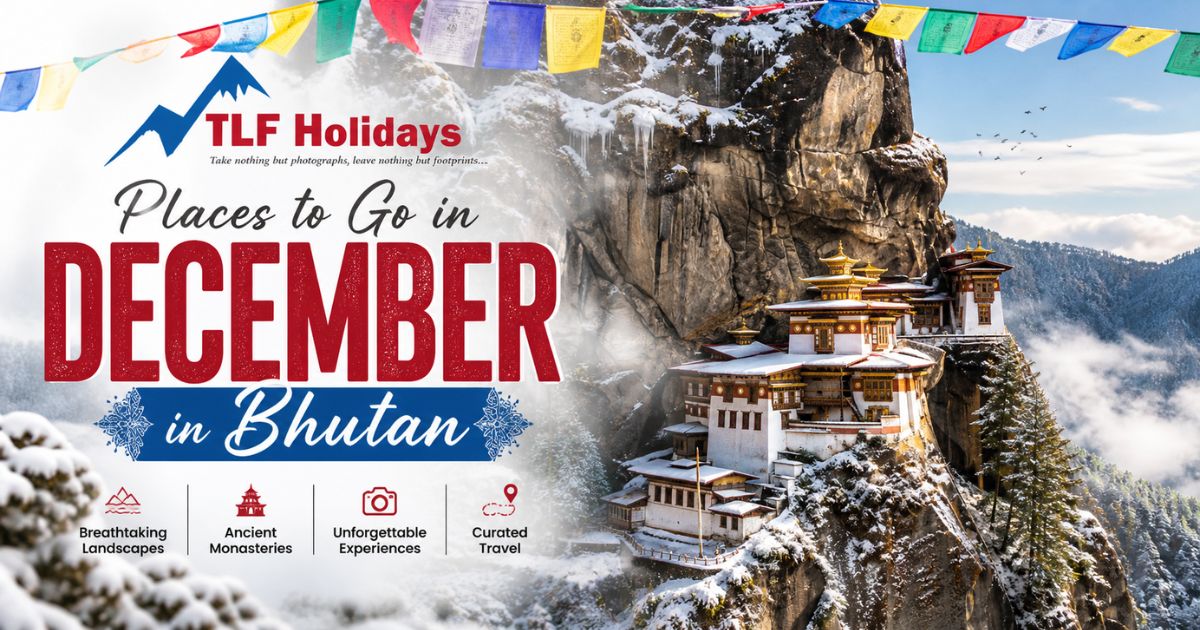
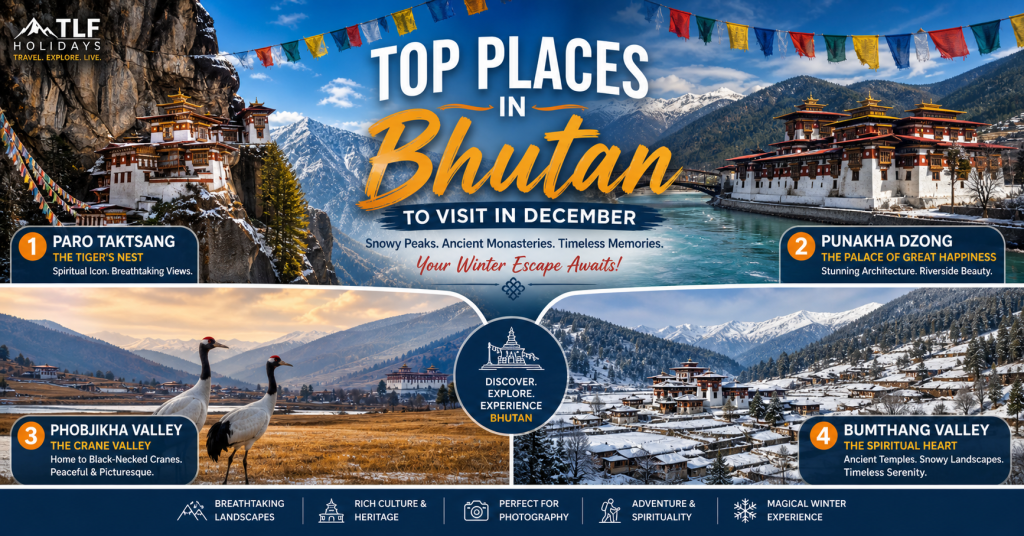
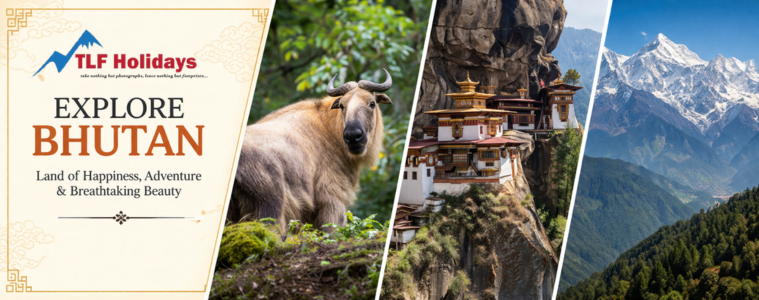
Paro Taktsang (Tiger’s Nest Monastery) is the crown jewel of any Bhutan itinerary, and December is one of the best times to hike it. The trail is less crowded, the air is sharp and invigorating, and on clear days (which December delivers in abundance), the surrounding peaks are breathtakingly visible. The hike takes 3–5 hours round-trip to the monastery perched 900 metres above the valley floor. In mid-to-late December, the cliffside may be dusted with snow — a sight that’s genuinely otherworldly.
Beyond Tiger’s Nest, spend time at Rinpung Dzong, a 17th-century fortress-monastery with whitewashed walls and intricately painted wooden interiors. Walk across its ancient cantilever bridge and wander through the dzong’s courtyards as sunlight streams through prayer wheel corridors. The National Museum of Bhutan, housed in a Ta Dzong watchtower, is also worth a visit for an immersive introduction to Bhutanese history and art.
For adventure seekers, the Druk Path Trek connects Paro with Thimphu via high alpine lakes and passes — while this is more challenging in December, the views of Jhomolhari (7,314m) on clear days are extraordinary.
December Highlight: The Paro valley glows golden in winter sunlight, creating magical conditions for photography between 8–10am and 3–5pm.
2. Thimphu – The World’s Only Carbon-Negative Capital
Thimphu is unlike any capital city you’ve visited before. There are no traffic lights (a traffic cop directs vehicles at the main junction). You won’t find any of the usual urban chaos. Instead, you’ll find a charming, culturally rich city where traditional Bhutanese architecture meets a modern, youthful energy.
In December, Thimphu comes alive with festive winter energy. The weekend market buzzes with traders selling everything from local cheese and dried yak meat to hand-woven textiles. Colourful prayer flags flutter against impossibly blue December skies.
Tashichho Dzong, the seat of Bhutan’s government and throne room of the King, stands with extraordinary grandeur in winter. Its whitewashed walls and golden rooftops against the clear winter sky make for some of the most photogenic shots in the country. The Buddha Dordenma statue — at 51.5 metres, one of the largest Buddha statues in the world — overlooks the valley through a veil of winter mist in December mornings, creating an almost mystical atmosphere.
Don’t miss the National Folk Heritage Museum and the Zorig Chusum Institute, where you can watch artisans practise Bhutan’s 13 traditional arts and crafts. The Centenary Farmers’ Market is a wonderful Saturday/Sunday experience — bring cash and browse stalls selling everything from chilli pepper condiments to local honey and handmade jewellery.
December Highlight: December daytime temperatures of 10–12°C make Thimphu sightseeing comfortable — cool enough to energize you, warm enough to enjoy a full day outside.
3. Punakha – Bhutan’s Warmest Winter Destination
If you’re looking for the perfect balance of culture and comfort in December, Punakha is your answer. Located at just 1,200 metres, it’s the warmest major destination in Bhutan during winter, with daytime temperatures reaching a pleasant 15–20°C — perfect for exploring without heavy winter gear.
Punakha Dzong, often described as Bhutan’s most beautiful, sits at the confluence of the Pho Chhu (Father River) and Mo Chhu (Mother River). In December, the rivers run calm and clear, and the dzong’s whitewashed walls reflect magnificently in the water. Inside, you’ll find some of the most exquisite religious art in all of Bhutan, including a preserved body of Zhabdrung Ngawang Namgyal, the founder of the Bhutanese state, in the Machen Lhakhang temple.
River rafting on the Mo Chhu is a surprisingly excellent December activity. With lower, calmer water levels, the rafting experience becomes more scenic and accessible — you float past river banks and get an entirely different perspective on the Punakha Dzong from the water.
Chimi Lhakhang, the Fertility Temple, is a charming 20-minute walk through rice paddy fields from the road. This temple dedicated to the “Divine Madman” Drukpa Kunley is a fascinating detour — particularly popular with couples hoping to start families, and endearingly quirky for all visitors.
Planning a Bhutan Tour Package from India with Permit or arriving from Singapore, Malaysia or Thailand? Punakha is almost always a cornerstone destination on TLF Holidays’ curated itineraries, and rightly so — it’s often the highlight of our guests’ entire trip.
December Highlight: Punakha’s warm winter climate makes it the most comfortable base for day trips to Dochula Pass (45 minutes away) when skies are clearest.
4. Dochula Pass – Bhutan’s Most Spectacular Mountain Viewpoint
Sitting at 3,100 metres between Thimphu and Punakha, Dochula Pass is one of those places that can genuinely stop you in your tracks. On clear December days (which are common), the 360-degree panorama reveals over 30 snow-capped Himalayan peaks, including Gangkhar Puensum (7,570m), the world’s highest unclimbed mountain.
The pass is adorned with 108 Druk Wangyal Chortens (stupas) built in honour of Bhutanese soldiers who lost their lives protecting the country. In December, these white-washed chortens may be dusted with snow, creating a scene of such sublime beauty that most visitors fall into silence.
The Druk Wangyal Tshechu, held every December 13th at this pass, is one of Bhutan’s most unique festivals. Unlike dzong festivals, this one is performed by the Royal Bhutanese Army in honour of the Fourth King, featuring elaborate masked dances (Cham dances), colourful silk costumes, and traditional music. It’s patriotic, deeply cultural, and completely free to attend. Plan your December itinerary around this date if you can — it’s genuinely unmissable.
December Highlight: Arrive at Dochula Pass early morning (before 9am) for the clearest views — afternoon cloud can sometimes drift in from the south.
5. Phobjikha Valley – The Black-Necked Crane Sanctuary
Phobjikha Valley is one of Bhutan’s most important wildlife habitats and one of its most scenically striking destinations. This glacial valley, cradled by rolling hills and pine forests, is the winter home of the Black-Necked Crane — a bird sacred to Bhutanese Buddhism that migrates here from Tibet every autumn and stays through February.
In December, up to 600–700 black-necked cranes can be seen gliding over the valley, gathering in the marshlands around Gangtey Monastery at sunset in a daily ritual that locals revere deeply. The Black-Necked Crane Festival (typically in November) may have passed, but December offers equally rewarding birdwatching with far fewer visitors.
Gangtey Gonpa, one of Bhutan’s most ancient monasteries perched above the valley, provides a breathtaking viewpoint over the entire valley. The short walking trail around the valley (about 5km) is a perfect December morning activity — crisp air, crane calls, and a complete sense of peace.
December Highlight: Visit the crane observation hide near Gangtey at dawn or dusk for the best viewing and photography opportunities.
6. Bumthang Valley – The Spiritual Heart of Bhutan
Bumthang is often called the “Switzerland of Bhutan” and for good reason. This cluster of four sub-valleys — Choekhor, Tang, Ura, and Chhume — forms Bhutan’s most sacred landscape, dotted with ancient monasteries, traditional farmhouses, and apple orchards.
December transforms Bumthang dramatically. By mid-to-late December, snowfall begins blanketing the valley and the surrounding peaks, turning the landscape into something from a Himalayan storybook. Jakar Dzong, the valley’s imposing fortress, looks particularly magnificent against a snow-covered backdrop.
The sacred sites of Bumthang are extraordinary year-round but feel especially atmospheric in winter when you may have them almost to yourself. Jambay Lhakhang, one of Bhutan’s oldest temples (built in the 7th century by the Tibetan king Songtsen Gampo), Kurjey Lhakhang (where a body print of Guru Rinpoche is preserved in the rock), and Tamshing Lhakhang (containing some of the oldest wall paintings in Bhutan) deserve extended, unhurried visits.
Bumthang cheese and honey are also famous throughout Bhutan — pick up locally produced red rice, buckwheat pancakes, and Swiss-style cheese at local farm stores for unique food experiences unavailable elsewhere in the country.
December Highlight: The late December snowfall in Bumthang creates once-in-a-lifetime photography conditions around the ancient temples. For snow, aim for December 20–31.
7. Haa Valley – Bhutan’s Hidden Winter Gem
Haa Valley is one of Bhutan’s most pristine and least-visited destinations — a remote, heavily forested valley close to the Tibetan border that was only opened to tourists in 2002. In December, it receives some of Bhutan’s heaviest snowfall, transforming it into a winter wonderland that feels entirely undiscovered.
The valley is home to Lhakhang Karpo (White Temple) and Lhakhang Nagpo (Black Temple), two ancient temples with profound spiritual significance. The sight of these white and black temples against a backdrop of snow-covered mountains in December is something you’ll remember for the rest of your life.
Haa is also one of the best destinations in Bhutan for those who want to experience authentic rural Bhutanese life — the valley’s villages are largely untouched by tourism, and the hospitality of locals is legendary.
December Highlight: Haa Valley sees significant snowfall from mid-December, making it the best destination in Bhutan for travellers specifically seeking a white-winter experience.
8. Wangdue Phodrang – The Underrated December Destination
Sitting between Punakha and Phobjikha Valley, Wangdue Phodrang is often overlooked in favour of its more famous neighbours — which is exactly what makes it special in December. The town occupies a commanding hilltop position above the confluence of two rivers, and its traditional Bhutanese streets are wonderfully quiet in winter.
The Wangdue Phodrang Dzong (currently being rebuilt after a devastating fire) is set to be one of Bhutan’s most impressive architectural achievements when restored. The surrounding landscape in December offers wonderful walking and light trekking opportunities.
December Festivals in Bhutan: Plan Your Dates
Bhutan’s festivals (Tshechus) are inseparable from any meaningful visit. December is home to some truly special celebrations:
Key December Festivals in Bhutan
| Festival | Location | Typical Dates | What to Expect |
| Druk Wangyal Tshechu | Dochula Pass | December 13 | Royal Army masked dances, patriotic celebration, mountain backdrop |
| Phuntsholing Tshechu | Phuntsholing | December 8–10 | Traditional Cham dances, Thongdrol unfurling, border-town energy |
| Mongar Tshechu | Mongar | Early December | Eastern Bhutan masked dances, local costumes |
| Trongsa Tshechu | Trongsa | Late December–January | Historic central Bhutan celebration |
Festival dates shift with the Bhutanese lunar calendar — confirm exact dates with TLF Holidays before booking.
Top Activities to Do in Bhutan in December
Beyond sightseeing, December in Bhutan offers a rich range of experiences:
Tiger’s Nest Hike (Paro): Best done in early morning when trails are frost-crisp and views are crystal clear. Allow a full day.
Mo Chhu River Rafting (Punakha): The calmer December waters make this one of the most enjoyable adventure activities of the trip.
Black-Necked Crane Watching (Phobjikha): A deeply moving wildlife experience unique to winter months.
Dochula Pass Sunrise Drive: Leave Thimphu at 6:30am to watch the sun rise over 30 Himalayan peaks — one of Asia’s great morning experiences.
Photography Tours: December light is exceptional — golden hours, blue skies, and snow-dusted temples create extraordinary compositions.
Cultural Cooking Classes: Some hotels offer Bhutanese cooking lessons in winter — learn to make Ema Datshi (chilli and cheese stew), red rice, and buckwheat crepes.
Village Walks in Bumthang: Explore traditional farmhouses, meet yak herders, and taste farm-fresh dairy products in a valley blanketed in winter quiet.
Essential Travel Information for December Visitors
Bhutan Visa & SDF Fee Guide for International Travelers
| Traveler Origin | Visa Required | SDF Fee | Children (6–12) | Children (Under 6) |
| Singapore, Malaysia, Thailand, other international | Yes – Tourist Visa via licensed operator | USD $100 per person/night | USD $50 per night | Free |
| India | Permit (no visa) | INR ₹1,200 per person/night | INR ₹600 per night | Free |
| Bangladesh | Visa (on arrival option) | USD $15/night (first 15,000 tourists/year) | 50% discount | Free |
| Maldives | Visa on arrival | USD $100 per person/night | USD $50 per night | Free |
SDF rates are valid from September 1, 2023 to August 31, 2027. Note: From January 1, 2026, a 5% GST applies to all tourism services (excluding SDF). Book before year-end for pre-GST pricing.
Important: All international visitors (except Indians who follow a separate permit process) must book through a licensed Bhutanese tour operator — independent travel is not permitted. TLF Holidays handles all permits, visa clearances, and SDF payments as part of your tour package. Learn more about how to customize your Bhutan tour packages with our expert team.
Suggested December Itinerary Overview by Duration
| Duration | Recommended Route | Highlights |
| 5 Days | Paro → Thimphu → Punakha → Paro | Tiger’s Nest, Punakha Dzong, Dochula Pass, Thimphu city |
| 7 Days | Paro → Thimphu → Punakha → Phobjikha → Paro | All of above + Black-Necked Cranes, Gangtey Monastery |
| 10 Days | Paro → Thimphu → Punakha → Phobjikha → Bumthang → Paro | Complete western + central Bhutan experience, possible snowfall |
| 12+ Days | Paro → Thimphu → Haa → Punakha → Phobjikha → Bumthang → Paro | Full Bhutan immersion including the remote Haa Valley |
What to Pack for Bhutan in December
Getting your packing right makes a significant difference to comfort. Here’s what our experienced TLF Holidays guests recommend:
Clothing: Thermal base layers (top and bottom), mid-layer fleece or sweater, heavy down jacket (essential), waterproof outer layer, warm hat, gloves, and a scarf. For Punakha, lighter layers suffice during the day.
Footwear: Sturdy waterproof hiking boots (mandatory for Tiger’s Nest), comfortable walking shoes for city sightseeing.
Accessories: Sunscreen (UV is intense at altitude even in winter), sunglasses, a good camera, portable charger, and a reusable water bottle.
Health: Consult your doctor about altitude adjustment. Carry personal medications, lip balm, and moisturizer as the air is very dry.
How to Get to Bhutan in December
By Air: Druk Air and Bhutan Airlines operate flights from Singapore, Bangkok (Thailand), Kuala Lumpur (Malaysia), Delhi, Kolkata, Mumbai, Kathmandu, and Dhaka. Paro International Airport, set in a narrow valley at 2,235 metres, is considered one of the world’s most challenging airports to land at — the approach is spectacular and unforgettable.
By Road (India border): Travelers from India can enter overland via Phuntsholing (West Bengal), Gelephu (Assam), or Samdrup Jongkhar (Assam). This is a popular choice for those booking a Bhutan Tour Package from India with Permit.
If you’re traveling from Singapore, Malaysia, or Thailand, flying directly to Paro is the most convenient option. TLF Holidays can assist with flight recommendations and connections as part of your full tour package.
Why Book Your December Bhutan Tour with TLF Holidays?
At TLF Holidays, we specialize in crafting meaningful, personalized Bhutan experiences — not cookie-cutter group tours. When you travel with us:
- All permits, visas, and SDF payments are handled seamlessly
- Your itinerary is designed around your interests, pace, and budget — learn how to customize your Bhutan tour
- Expert local guides bring Bhutan’s history, culture, and nature to life
- We handpick accommodations from cosy heritage properties to boutique luxury retreats
- December-specific logistics (festival timings, snow-accessible routes, warm valley alternatives) are expertly managed
Whether you’re a solo explorer from Singapore, a couple from Kuala Lumpur planning a romantic winter getaway, or a family from Bangkok looking for an extraordinary holiday experience, we’re here to make your Bhutan December trip extraordinary.
Conclusion:
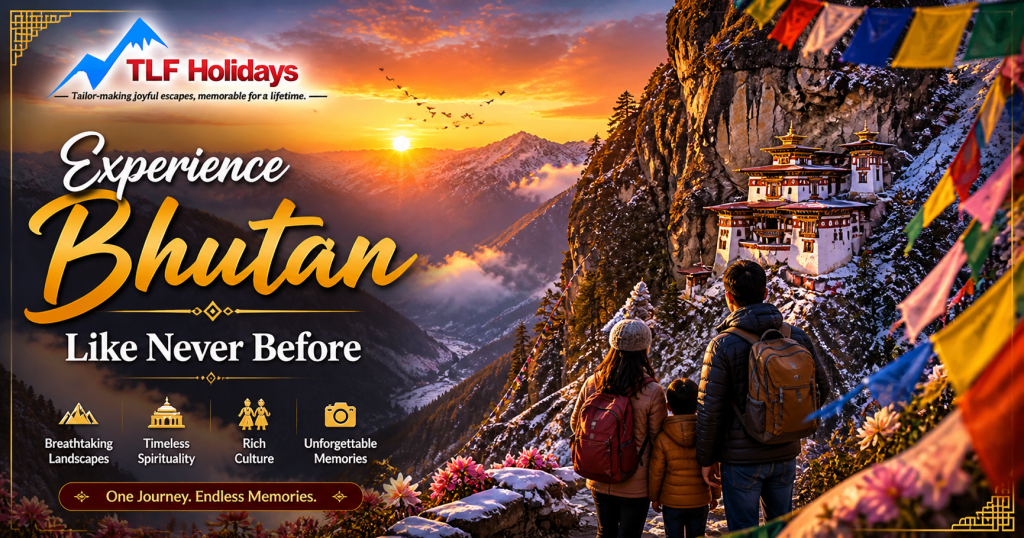
Bhutan in December is not for everyone — and that’s precisely its beauty. It requires a willingness to trade a beach holiday for something more profound: snow-dusted monasteries, silent valleys where cranes dance at sunset, festivals watched by firelight, and the kind of human warmth that only comes from a place that genuinely values happiness above all else.
The places in this guide — Paro, Thimphu, Punakha, Dochula Pass, Phobjikha, Bumthang, Haa, and Wangdue — each offer something different in December, but together they paint a complete picture of Bhutan at its most intimate and most beautiful. Fewer tourists means more meaningful conversations, more space in sacred sites, and a more authentic connection with this remarkable kingdom.
If you’re ready to plan your December Bhutan adventure, TLF Holidays is ready to help. Contact us today, tell us what you dream of seeing, and we’ll build the perfect itinerary — one that takes you beyond the guidebooks and into the real heart of the Land of the Thunder Dragon.
Frequently Asked Questions
Q1: Is December a good time to visit Bhutan?
Yes, December is an excellent time to visit Bhutan. While it’s the off-peak season with cooler temperatures, it offers clear skies, fewer tourists, spectacular mountain views, unique festivals like the Druk Wangyal Tshechu, and the possibility of snowfall in higher valleys. Lower-altitude destinations like Punakha are particularly comfortable.
Q2: What is the temperature in Bhutan in December?
Temperatures vary significantly by altitude. Punakha (1,200m) is warmest at 15–20°C during the day. Thimphu and Paro range from 10–14°C in the day with freezing nights. Bumthang and Haa can see temperatures drop to -10°C to -15°C at night in late December, with snowfall.
Q3: Does it snow in Bhutan in December?
Yes, snowfall is possible in Bhutan in December, particularly from mid-to-late December. Bumthang, Haa Valley, and Dochula Pass (3,100m) are the most likely destinations to receive snowfall. Paro and Thimphu may see occasional light snow, while Punakha rarely sees any.
Q4: Is Bhutan expensive to visit in December?
December is Bhutan’s off-peak season, meaning accommodation rates and tour costs are often lower than in peak spring or autumn months. International visitors pay USD $100 per person per night as a Sustainable Development Fee (SDF) regardless of season. Indian visitors pay INR ₹1,200 per night. However, overall trip costs are more affordable in December due to lower hotel pricing and tour package rates.
Q5: Do I need a visa to visit Bhutan from Singapore, Malaysia, or Thailand?
Yes. Travelers from Singapore, Malaysia, Thailand, and most other countries require a Tourist Visa to enter Bhutan. This must be arranged through a licensed Bhutanese tour operator (like TLF Holidays) and cannot be obtained independently. Indian nationals require a permit rather than a visa.
Q6: Can I visit Bhutan independently in December?
No. All international visitors (except Indian, Bangladeshi, and Maldivian nationals who follow a separate process) must travel through a licensed Bhutanese tour operator. Independent travel is not permitted. TLF Holidays handles all logistics including visa clearance, SDF payments, accommodation, and licensed guides.
Q7: What festival happens in Bhutan in December?
The most notable December festival is the Druk Wangyal Tshechu held on December 13 at Dochula Pass (3,100m). It features masked Cham dances performed by the Royal Bhutanese Army against a backdrop of 108 chortens and Himalayan peaks. The Phuntsholing Tshechu (December 8–10) in the southern border town is another option.
Q8: Is Tiger’s Nest accessible in December?
Yes, Tiger’s Nest (Paro Taktsang) is accessible in December. The hike takes approximately 3–5 hours round-trip. On clear December days, the views are exceptional. Dress in layers and wear sturdy hiking boots, as lower sections of the trail can be frosty in the morning. In cases of heavy snowfall (rare in Paro), the trail may temporarily close.
Q9: Which is the warmest place in Bhutan in December?
Punakha is the warmest major tourist destination in Bhutan in December, with daytime temperatures of 15–20°C. It’s an ideal base for those who want comfortable winter sightseeing while still being within reach of the Dochula Pass mountain views.
Q10: How do I book a December Bhutan tour from Singapore, Malaysia, or Thailand?
Simply contact TLF Holidays with your travel dates, group size, interests, and budget. We handle everything from there — visa clearance, SDF payments, accommodation, transport, and an experienced English-speaking guide. You can also explore our customized itinerary options at tlfbhutan.com.

Comments (24)
Ada946,
05 May, 2026https://shorturl.fm/LjHNL
Piper2902,
05 May, 2026https://shorturl.fm/X8Mmi
Alyssa4544,
05 May, 2026https://shorturl.fm/VbV2h
Donald1269,
05 May, 2026https://shorturl.fm/mRWtW
Joel586,
05 May, 2026https://shorturl.fm/t4QSf
Daisy3950,
05 May, 2026https://shorturl.fm/3CzXd
Alissa1359,
05 May, 2026https://shorturl.fm/AuY29
Susan4220,
05 May, 2026https://shorturl.fm/VVxHG
Anna2604,
05 May, 2026https://shorturl.fm/RFphp
Darryl2548,
05 May, 2026https://shorturl.fm/1XZLg
Audrey1033,
06 June, 2026https://shorturl.fm/SSsXc
Bill4732,
06 June, 2026https://shorturl.fm/lh5s8
Alana3566,
06 June, 2026https://pesnimp3.net
Sophia3108,
06 June, 2026https://shorturl.fm/TQcQX
Cleo3569,
06 June, 2026https://shorturl.fm/jx06w
Russell2849,
06 June, 2026https://shorturl.fm/edALu
Samuel3616,
06 June, 2026https://shorturl.fm/IEMRQ
Shelby1524,
06 June, 2026https://shorturl.fm/TWoJx
Hamilton536,
06 June, 2026https://shorturl.fm/u8MuB
Jared3538,
06 June, 2026https://shorturl.fm/8YADQ
Grace955,
06 June, 2026https://shorturl.fm/LXq4J
Lily4045,
06 June, 2026Последние новинки музыки 2026 скачать бесплатно – https://shorturl.fm/rrdv9
Alaina192,
06 June, 2026https://shorturl.fm/M8nOW
Margaret1394,
06 June, 2026https://shorturl.fm/BjPaF