



- 516 Views
- 17 Min Read
- (14) Comments
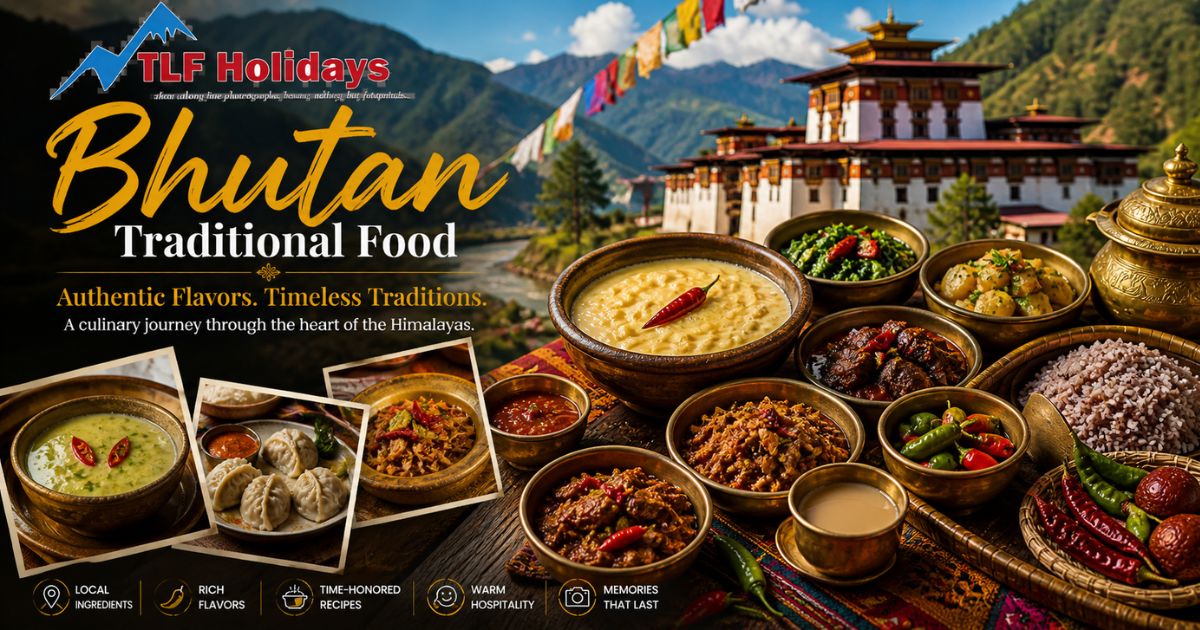
If you are planning a trip to Bhutan, you already know that this Himalayan kingdom offers more than just stunning monasteries and mountain views. Bhutan traditional food is one of the most underrated aspects of the entire travel experience — bold, fiery, comforting, and deeply rooted in culture. From the iconic Ema Datshi, often called the national dish, to warming bowls of butter tea served at altitude, traditional food in Bhutan tells the story of a people shaped by high mountains, cold winters, and centuries of Buddhist tradition.
At TLF Holidays, a Bhutan-based Destination Management Company established in 2003 and licensed by the Department of Tourism, Bhutan, we have helped thousands of international travellers experience Bhutan the right way — including making sure they eat the right things. This guide covers everything you need to know about famous Bhutanese dishes, where to find them, what to expect if you are vegetarian or non-vegetarian, and how to make the most of Bhutan’s extraordinary food culture.
Why Bhutan Traditional Food is Unique for Tourists
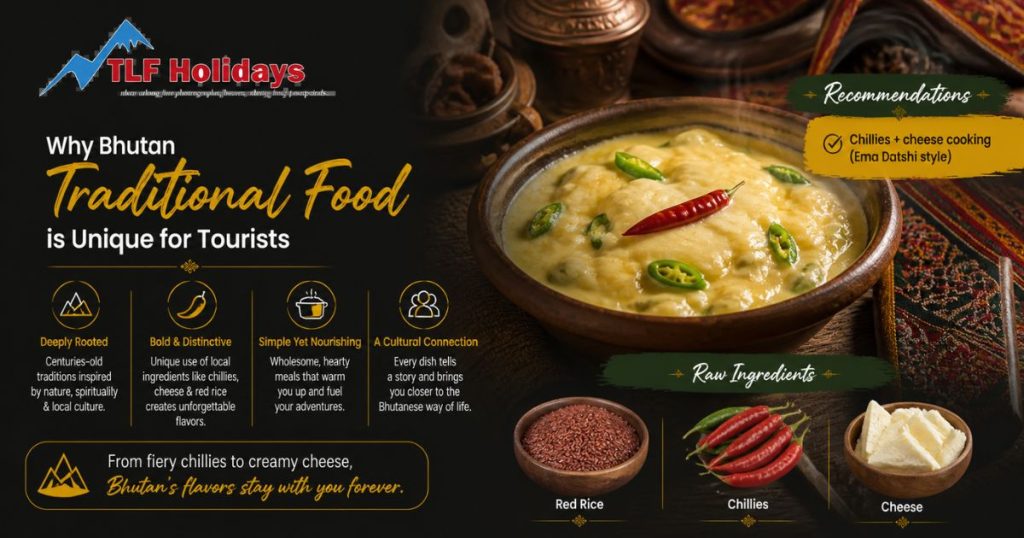
The simplest answer is this: nowhere else in the world will you find a national cuisine built around chillies as a vegetable, not a spice. In most countries, chillies are used sparingly to add heat. In Bhutan, whole green and red chillies are the heart of almost every meal — stir-fried, simmered, roasted, and eaten in enormous quantities.
Here is why Bhutan traditional food culture stands apart from the rest of Asia:
Cheese (Datshi) is a staple: Bhutanese yak and cow cheese called datshi is used the way South Indians use coconut or East Asians use soy — it is foundational. Creamy, salty, and pungent, it melts into sauces and transforms simple vegetables into incredibly satisfying curries.
Altitude-driven ingredients: The mountainous terrain means Bhutan grows crops that thrive in cool, high-altitude climates — red rice, buckwheat, barley, and a wide variety of mushrooms and root vegetables that are unique to this region.
Minimal processed food: Traditional Bhutanese cooking is almost entirely farm-to-table. Meat is often dried or smoked — dried pork and dried beef — as a preservation method developed over centuries without refrigeration.
Buddhist influence: While Bhutan is not a strictly vegetarian country, the influence of Vajrayana Buddhism encourages mindful eating and respect for living beings. Many households limit meat consumption, and vegetarian options are abundant across the country.
Red rice, not white: Bhutan’s primary staple grain is a short-grain red rice grown in the Paro and Punakha valleys. It has a firm, slightly chewy texture and a nutty flavour that travellers from Thailand, Malaysia, and Singapore often find surprisingly familiar — like a cross between Thai red rice and Japanese short-grain rice.
Top 10 Bhutan Traditional Dishes — Quick Reference
Before we dive deep into each dish, here is your at-a-glance overview of the most famous Bhutanese dishes you must try:
| # | Dish Name | Main Ingredients | Best For |
| 1 | Ema Datshi | Chilli peppers, yak cheese | Everyone — Bhutan’s national dish |
| 2 | Phaksha Paa | Pork, dried red chillies, radish | Non-veg lovers |
| 3 | Red Rice | Bhutanese red rice | All travellers — served with every meal |
| 4 | Jasha Maru | Minced chicken, tomatoes, spices | Chicken lovers |
| 5 | Hoentoe | Buckwheat, turnip, cottage cheese | Vegetarians, trekkers in Haa Valley |
| 6 | Shakam Paa | Dried beef, dried chillies, radish | Non-veg / adventure foodies |
| 7 | Kewa Datshi | Potato, cheese, chillies | Vegetarians |
| 8 | Shamu Datshi | Mushrooms, cheese, chillies | Vegetarians |
| 9 | Suja (Butter Tea) | Yak butter, tea, salt | Everyone — traditional welcome drink |
| 10 | Zow Shungo | Leftover rice, vegetables | Comfort food, budget travellers |
Top 10 Bhutan Traditional Dishes — A Deep Dive
1. Ema Datshi — The National Dish of Bhutan
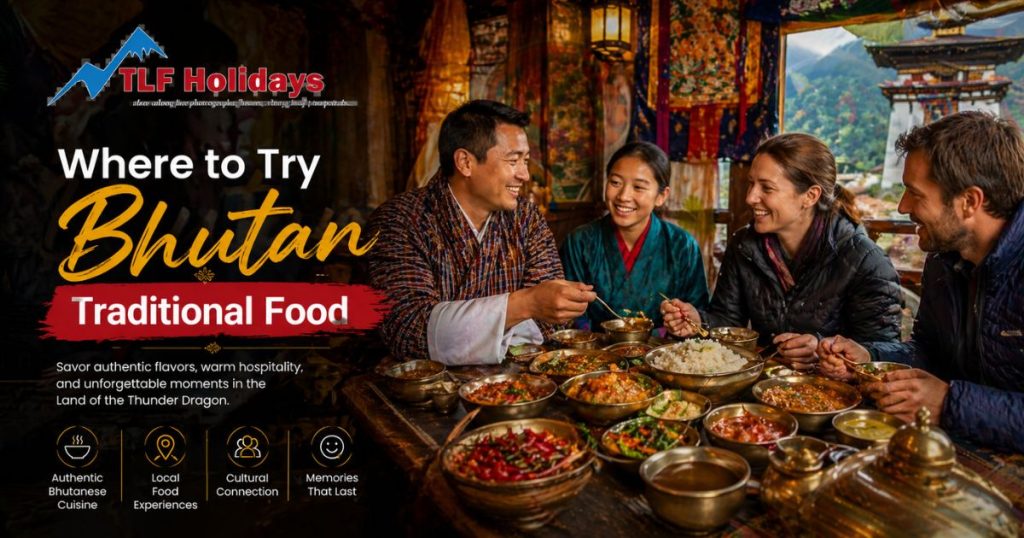
If there is one dish that defines Bhutan traditional food, it is Ema Datshi. The name literally means “chilli-cheese” in Dzongkha, the national language of Bhutan. Whole green or red chillies — not chopped, not puréed — are simmered in a sauce made from local datshi cheese, sometimes with butter and onions added for depth.
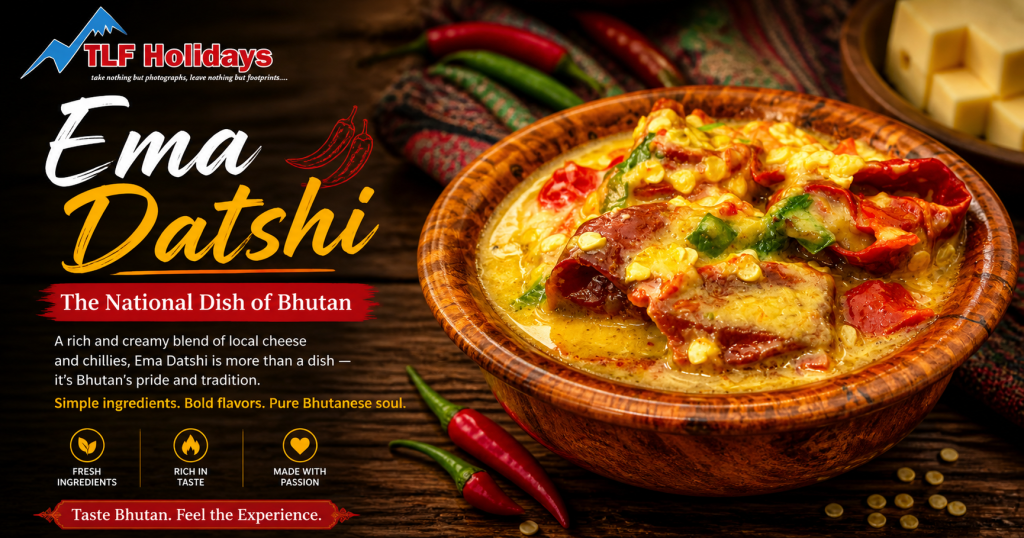
What arrives at your table looks deceptively simple but packs extraordinary flavour. The cheese melts into the chilli-cooking liquid to create a rich, slightly sour, intensely savoury sauce that clings to red rice perfectly. Every Bhutanese household has its own version of Ema Datshi — some prefer it dry, others soupy, some add tomatoes, others keep it strictly chilli and cheese.
Traveller tip: If you are not used to extreme heat, ask the restaurant to make a “tourist version” with fewer chillies. Most restaurants in Thimphu and Paro are very accustomed to this request from international visitors.
2. Phaksha Paa — Pork with Dried Red Chillies
One of the most beloved traditional food in Bhutan for non-vegetarians, Phaksha Paa is a hearty pork dish slow-cooked with dried red chillies, radishes, and sometimes leafy greens. The pork used is often fatty, which may initially raise eyebrows for Southeast Asian travellers, but the richness is entirely intentional — it provides the warmth and calories needed in a cold mountain climate.
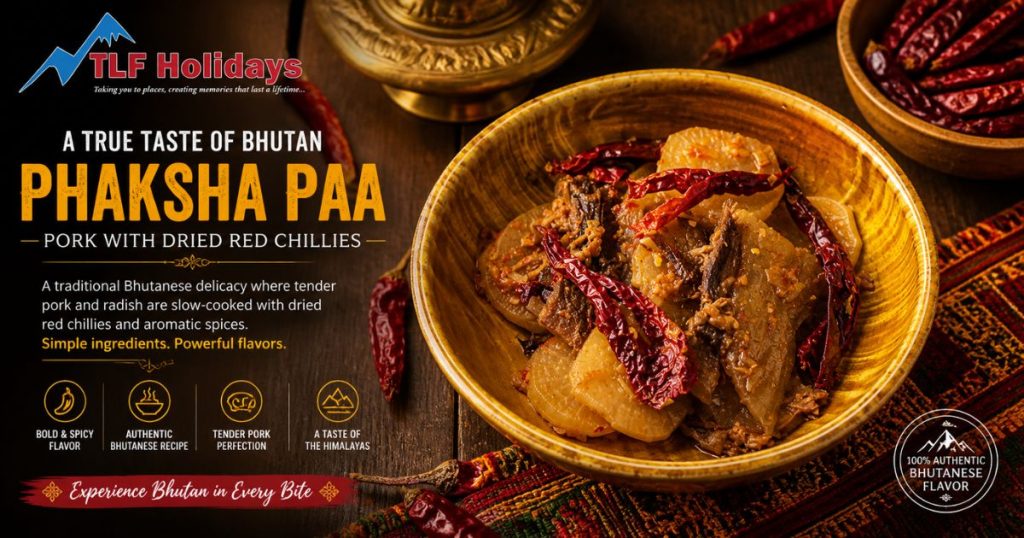
The dish is prepared differently across regions. In western Bhutan around Thimphu and Paro, it tends to be drier and more concentrated. In eastern Bhutan, you may find it soupier, almost like a stew. Either way, it is absolutely delicious when paired with Bhutanese red rice.
3. Bhutanese Red Rice — The Soul of Every Meal
Bhutanese red rice deserves its own mention because it is not merely a side dish — it is the foundation upon which all Bhutanese meals are built. Grown primarily in the Paro Valley, this short-grain rice gets its reddish-brown colour from the bran layer left intact during milling.
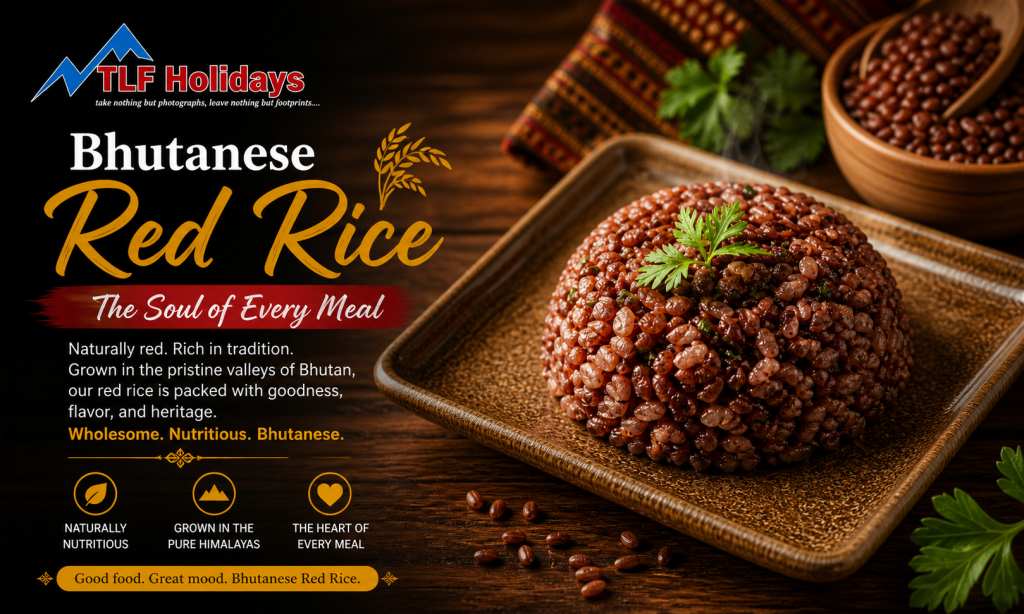
Compared to white rice, Bhutanese red rice has more fibre, a lower glycaemic index, and a complex, slightly earthy flavour. For travellers from Thailand, Singapore, and Malaysia where rice is equally central to daily eating, Bhutanese red rice will feel like both familiar comfort and exciting novelty. It is also naturally gluten-free and nutritious — a perfect partner for the cheese-laden datshi curries.
4. Jasha Maru — Spicy Minced Chicken
Jasha Maru is Bhutan’s most popular chicken preparation and a great introduction to Bhutanese cuisine for those who find the stronger flavours of dried beef or pork challenging. Minced or shredded chicken is stir-fried with onions, tomatoes, garlic, ginger, fresh chillies, and a blend of local spices.
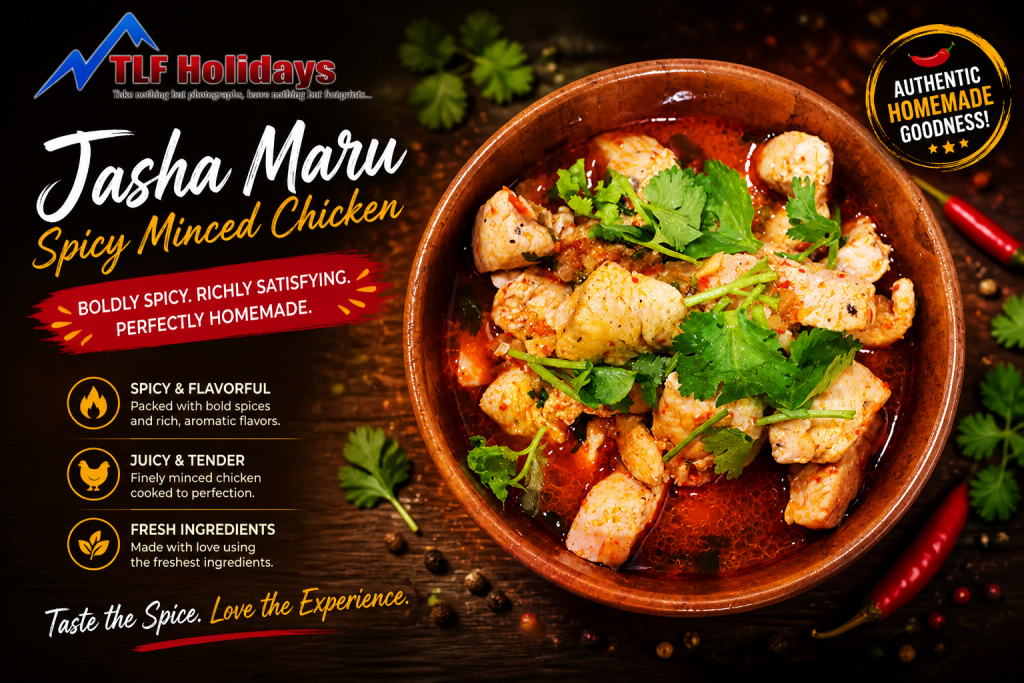
The dish is quick to cook, deeply fragrant, and has a texture similar to keema dishes found in South Asian cooking — which makes it an easy crowd-pleaser for travellers from Southeast Asia who enjoy bold, aromatic flavours. It is widely available in restaurants across Thimphu and Paro, making it a reliable choice for first-timers to Bhutanese food.
5. Hoentoe — Buckwheat Dumplings from Haa Valley
While momos (Tibetan-style dumplings) are common throughout the Himalayas, Hoentoe is specifically Bhutanese — a half-moon shaped buckwheat dumpling filled with a mixture of turnip greens, cottage cheese, spinach, and sometimes dried pork.
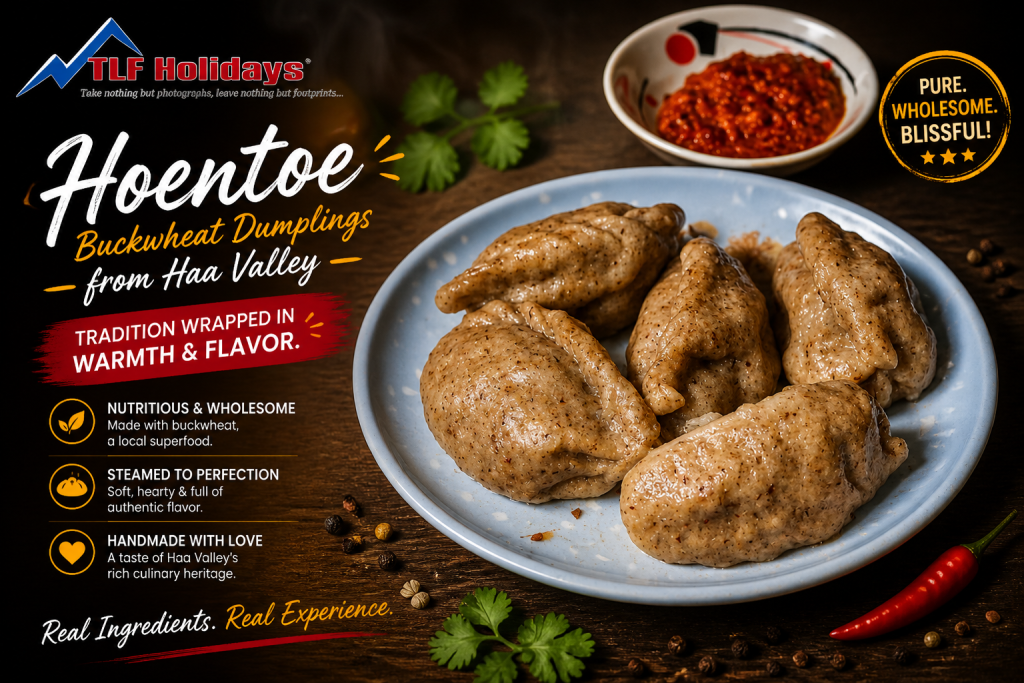
Hoentoe originates from the Haa Valley in western Bhutan and is an essential part of local festivals and family gatherings. The buckwheat wrapper has a distinctive earthy, slightly bitter flavour that contrasts beautifully with the savoury filling. Travellers who enjoy Japanese soba noodles or Korean buckwheat dishes will find something familiar and exciting in Hoentoe. It is also a wonderful vegetarian option in Bhutan when made without the dried pork filling.
6. Shakam Paa — Dried Beef with Chillies
Shakam Paa is one of Bhutan’s oldest and most traditional dishes, a product of the country’s time-honoured method of preserving meat by drying it in the cold mountain air. Strips of dried beef are rehydrated and cooked with dried red chillies and radish, creating an intensely flavoured, chewy, smoky dish that speaks directly to Bhutan’s highland heritage.
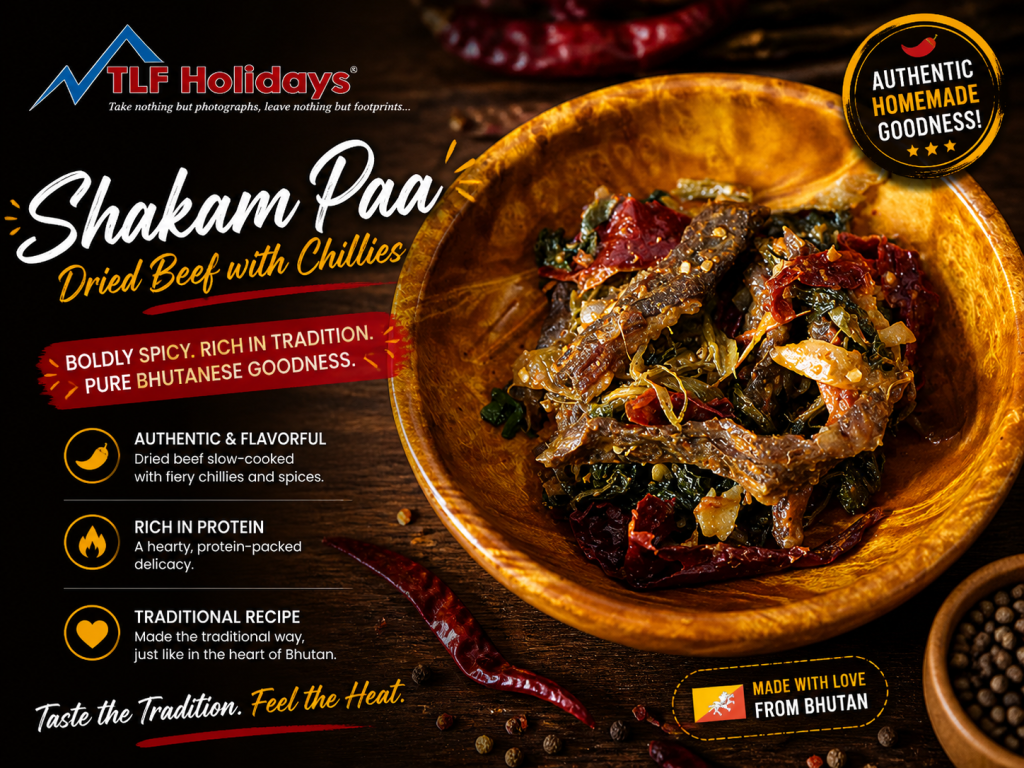
The flavour is bold and complex — the drying process concentrates the beef’s natural umami, and the chillies add heat while the radish brings a gentle sweetness. If you are an adventurous foodie who loves trying genuinely local, time-tested recipes, Shakam Paa is unmissable. It is best found in Bumthang, Bhutan’s cultural heartland.
7. Kewa Datshi — Potato and Cheese Curry
Kewa Datshi is one of the most approachable dishes in Bhutan traditional food — sliced potatoes simmered in the same creamy datshi cheese sauce as Ema Datshi, but with chillies playing a supporting rather than starring role. It is mild enough for those with lower spice tolerance and is a firm favourite among vegetarian travellers.
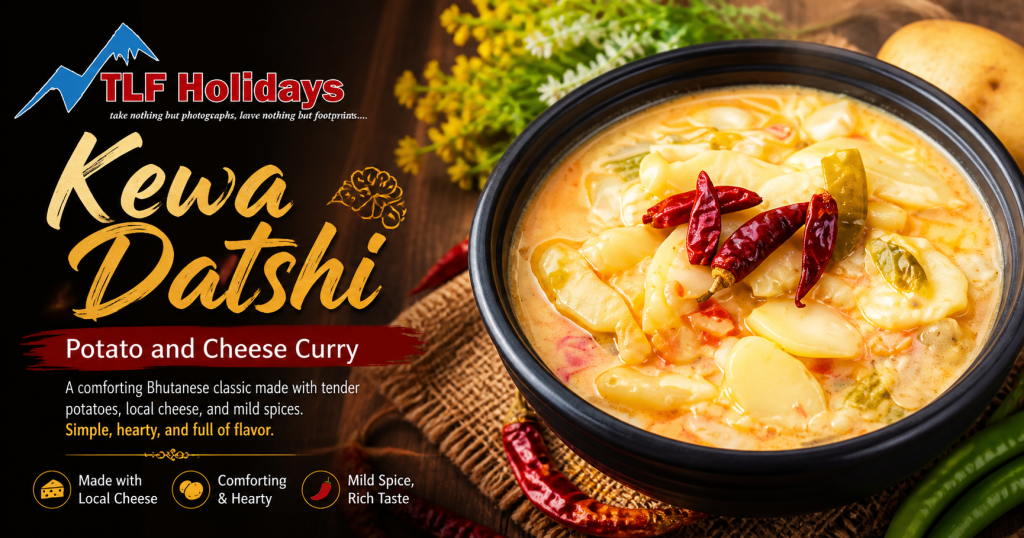
Think of it as a Bhutanese twist on a cheesy potato gratin — hearty, satisfying, and deeply comforting after a day of trekking or sightseeing. Every restaurant in Bhutan serves Kewa Datshi, which makes it a dependable choice when you are unsure what to order.
8. Shamu Datshi — Wild Mushroom and Cheese Curry
Bhutan’s forests are home to extraordinary varieties of wild mushrooms, and Shamu Datshi celebrates this natural abundance. Mushrooms — which can include oyster mushrooms, shiitake, or wild forest varieties depending on the season — are cooked in the signature datshi cheese sauce with chillies.
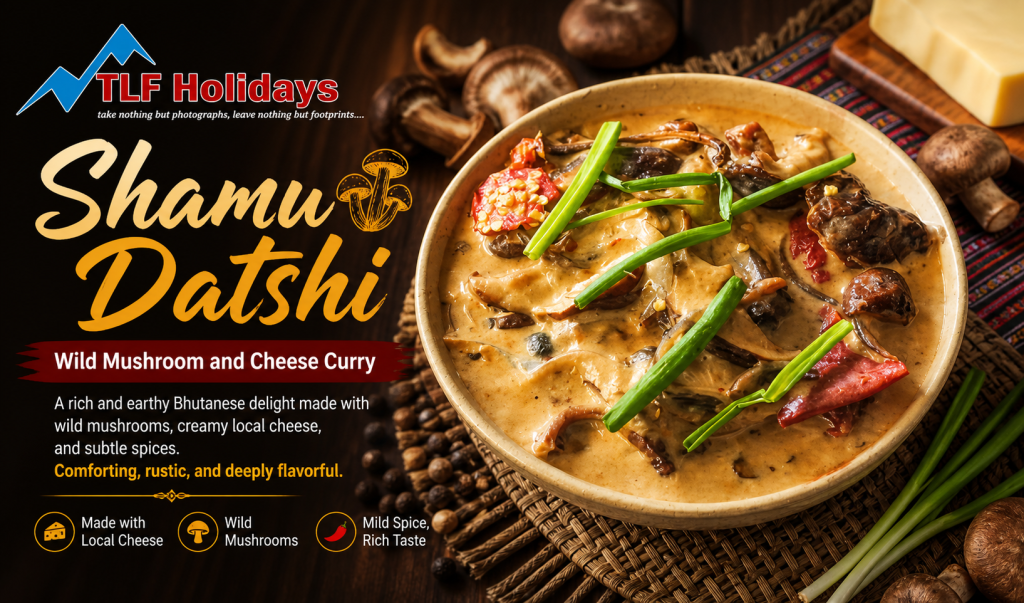
For travellers from Singapore, Thailand, and Malaysia where mushroom-based dishes are both common and beloved, Shamu Datshi will feel surprisingly familiar in spirit while being entirely unique in flavour. It is one of the best vegetarian dishes in Bhutan and should not be missed, especially during the autumn mushroom season from September to November.
9. Suja — Butter Tea, the Bhutanese Welcome Drink
No guide to famous Bhutanese dishes is complete without Suja, the iconic Bhutanese butter tea. Made by churning strong brewed tea with yak butter and salt, Suja is thick, rich, slightly oily, and decidedly savoury — completely unlike any tea most international travellers have experienced.
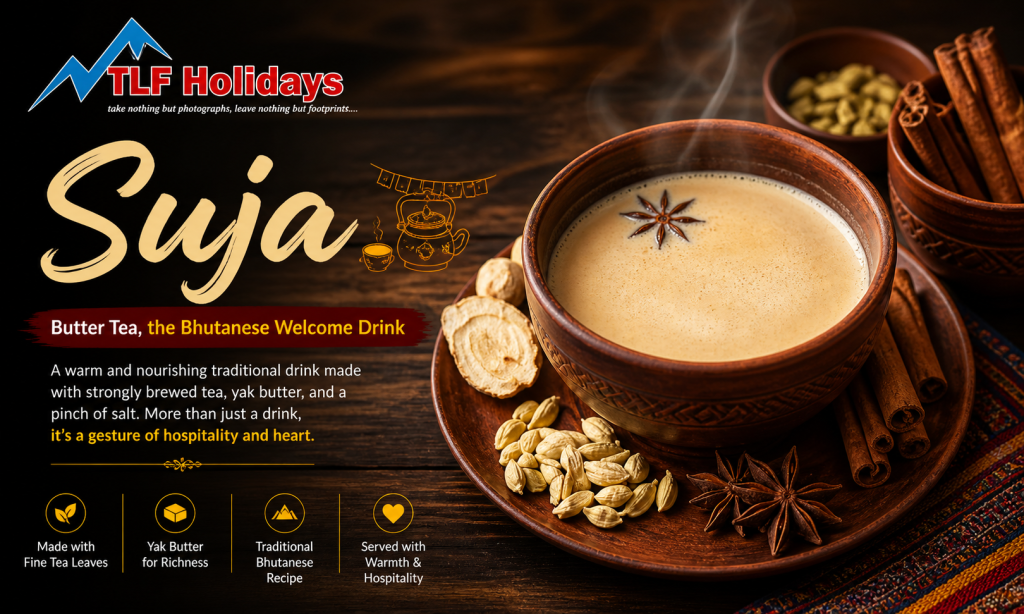
It is traditionally offered to every guest as a sign of welcome and hospitality. In cold mountain regions, Suja is practically a meal in itself, providing fat, calories, and hydration in one cup. Do try it even if the idea sounds unusual — the experience is deeply embedded in Bhutan’s food and culture. If the flavour is too strong, sweet milk tea (ngaja) is always available as an alternative.
10. Zow Shungo — The Comfort Bowl
Zow Shungo is essentially Bhutan’s version of a fried rice bowl — leftover rice cooked together with whatever vegetables, greens, and sometimes meat are available. It sounds humble, but Zow Shungo is a wonderful expression of Bhutanese home cooking: resourceful, warming, and full of genuine flavour.
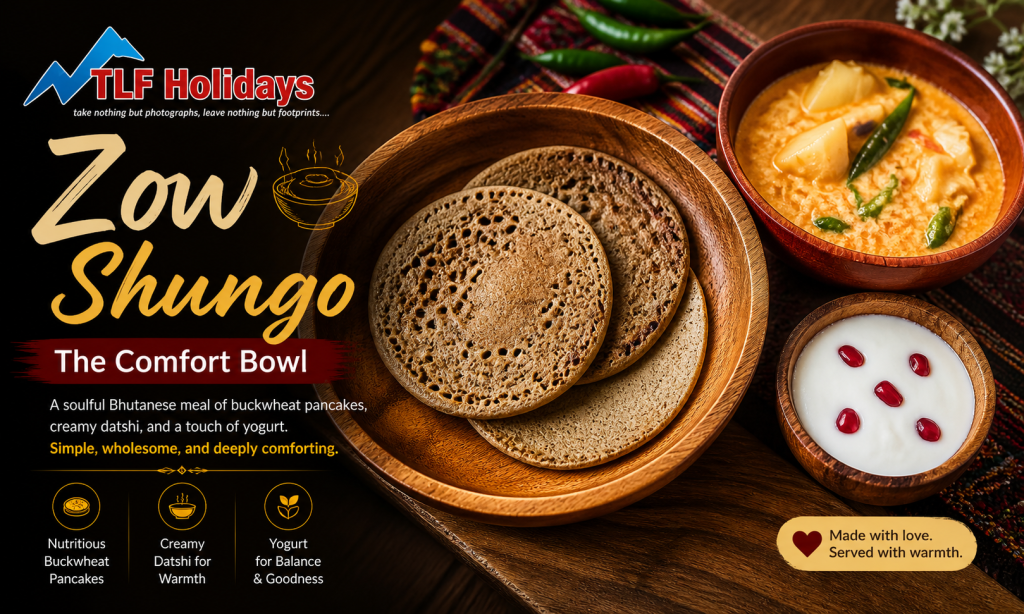
You will most commonly encounter it at homestays and smaller local eateries rather than in tourist restaurants. If you get the chance to eat Zow Shungo prepared by a Bhutanese family, you are experiencing food in its most authentic, unpretentious form — and that is always the best kind of travel experience. At TLF Holidays, our homestay-inclusive tour experiences are designed to give you exactly these kinds of real, unscripted moments.
Book a Bhutan tour package with us at TLF Holidays
Vegetarian vs Non-Veg Options in Bhutan Traditional Food
One of the most common questions we receive from travellers planning a Bhutan tour is: “Will there be enough food for me as a vegetarian?” The answer is a resounding yes. Bhutanese cuisine is remarkably vegetarian-friendly, largely because the datshi (cheese) cooking tradition lends itself naturally to vegetables.
| Category | Dish | Key Feature | Where to Find |
| Vegetarian | Ema Datshi | National dish — chilli and cheese | All restaurants across Bhutan |
| Vegetarian | Kewa Datshi | Potato and cheese curry | Thimphu, Paro local eateries |
| Vegetarian | Shamu Datshi | Wild mushroom and cheese | Thimphu, Bumthang |
| Vegetarian | Hoentoe | Buckwheat dumplings with turnip | Haa Valley, Thimphu |
| Vegetarian | Puta (Buckwheat Noodles) | Earthy, nutty noodles | Haa Valley, trekking areas |
| Non-Veg | Phaksha Paa | Pork with dried red chillies | Local restaurants, Thimphu |
| Non-Veg | Jasha Maru | Minced spicy chicken stew | Thimphu, Paro dhabas |
| Non-Veg | Shakam Paa | Dried beef with chillies | Traditional homes, Bumthang |
| Non-Veg | Shakam Ema Datshi | Dried beef and chilli cheese mix | Countryside eateries |
| Non-Veg | Zow Shungo with meat | Comfort rice bowl with leftover meat | Homestays, small eateries |
Where to Try Bhutan Traditional Food — City by City Guide
Knowing what to eat in Bhutan is only half the battle — you also need to know where to find the best authentic experiences. Here is our city-by-city guide, drawn from TLF Holidays’ 20+ years of on-the-ground expertise in Bhutan.
Thimphu — The Capital and Culinary Hub
Thimphu is Bhutan’s capital city and the best place to begin your culinary exploration. The city has a healthy mix of traditional restaurants, modern cafés, and local eateries (dhabas) that serve everything from authentic Ema Datshi to Bhutanese-Indian fusion. The Folk Heritage Museum restaurant in Thimphu is particularly well-regarded for serving traditional Bhutanese thalis in an authentic, museum-style setting.
Clock Tower Square and the area around Norzin Lam are dotted with restaurants catering to all budgets. If you are staying in Thimphu as part of a Bhutan tour package, ask your TLF Holidays guide to take you to local eateries where residents actually eat — the food is more authentic and considerably more affordable than tourist-facing restaurants.
Paro — Where Food Meets Festival Culture
Paro is home to Bhutan’s only international airport and the gateway city for most international arrivals. It is also one of the most beautiful valleys in Bhutan, surrounded by rice paddies and ancient dzongs. Restaurants in Paro tend to serve food with slightly more refined presentation than smaller towns, while still using completely authentic local ingredients.
After hiking up to the famous Tiger’s Nest monastery (Paro Taktsang), a meal of Phaksha Paa and red rice with a cup of hot Suja is one of the most rewarding culinary experiences you will have in Bhutan. Many of TLF Holidays’ Bhutan tour packages include Paro as a key destination, and our guides know exactly which local spots to recommend.
Phuentsholing — The Gateway for India Route Travellers
Phuentsholing is Bhutan’s main border town, sitting at the frontier with West Bengal, India. It has a unique food culture that blends Bhutanese and Indian influences — you will find authentic datshi dishes alongside Indian dals, curries, and chai. For travellers entering Bhutan by road from India, Phuentsholing is typically the first Bhutanese food experience, and it is a great warm-up for the more distinctly Bhutanese flavours you will encounter further into the country. If you are interested in exploring this route, our Bhutan Tour Package from India with Permit: The Complete 2026 Travel Guide covers everything you need to know about the overland journey.
| City | Recommended Dish | Type of Venue | TLF Holidays Tip |
| Thimphu | Ema Datshi, Jasha Maru, Hoentoe | Restaurants, local eateries, cafés | Visit Folk Heritage Museum restaurant for authentic Bhutanese thali |
| Paro | Phaksha Paa, Red Rice, Suja | Traditional inns, resort dining | Pair your meal with a Paro Valley view after Tiger’s Nest hike |
| Phuentsholing | Indo-Bhutanese fusion, Datshi dishes | Border town restaurants, dhabas | Great stop on the India–Bhutan overland route with diverse food options |
| Bumthang | Shakam Paa, Buckwheat items, Red Rice | Farmhouses, small local restaurants | Best region for truly home-cooked, authentic Bhutanese meals |
Bhutan Food Guide for Travellers from Singapore, Thailand & Malaysia
As a travel company that works extensively with Southeast Asian travellers, we know you have specific questions about eating in Bhutan. Here are the answers:
| Your Concern | What You Need to Know |
| Spice Level | Bhutanese food is very spicy by default. Restaurants catering to tourists can adjust spice levels — always ask for a milder version when ordering. |
| Vegetarian Options | Plenty available. Datshi dishes (cheese-based curries) are all vegetarian. Most menus have clear veg/non-veg options. |
| Halal Food | Limited halal-certified options. Vegetarian dishes are the safest choice for Muslim travellers. Inform TLF Holidays in advance and we will assist with arrangements. |
| Familiar Tastes | Red rice has a nutty flavour similar to Thai red rice. Datshi curries share similarities with Southeast Asian coconut-free curries in terms of depth and richness. |
| Drinks | Bottled water widely available. Suja (butter tea) is a must-try. Local Ara (rice wine) is popular among adventurous travellers. |
| Dining Budget | Local meals: USD 3–8. Tourist restaurants: USD 10–20. Most meals are included in TLF Holidays tour packages. |
Experiencing Bhutan Traditional Food Through Authentic Itineraries
Food is not a separate activity during a Bhutan trip — it is woven into every experience. Whether you are attending a Tsechu festival where traditional food stalls are a central attraction, visiting a farmhouse in Bumthang, or simply sitting down to dinner after a day of exploring dzongs and monastery trails, every meal in Bhutan is connected to the country’s cultural fabric.
At TLF Holidays, we design our itineraries with food experiences genuinely in mind — not as an afterthought but as a real highlight. Our Bhutan Cultural Tours include traditional meal experiences at local homes, monastery visits where you can observe how monks eat, and guided food walks in Thimphu’s local markets. If you would like a trip specifically tailored around your food preferences, dietary requirements, or culinary curiosity, we can build that for you from the ground up.
You can explore our full customization options through our guide on How to Customize Bhutan Tour Packages with TLF Holidays Bhutan — whether you need more vegetarian stops, specific regional cuisine experiences in Haa Valley or Bumthang, or a fully private culinary-focused itinerary, we can make it happen.
Want to explore Bhutan’s food and culture? Book a Bhutan tour package with us at TLF Holidays and let our local experts handle every detail — from your permit to your dinner table. View Our Bhutan Tour Packages →
Conclusion
Bhutan traditional food is a journey in itself — bold, warm, surprising, and deeply satisfying. From the fiery simplicity of Ema Datshi to the rustic complexity of Shakam Paa, from the earthy comfort of Bhutanese red rice to the ritualistic warmth of Suja butter tea, every dish tells you something true about this extraordinary kingdom.
For travellers Bhutan’s food culture offers something genuinely rare: a cuisine almost entirely untouched by globalisation, built from mountain landscapes and Buddhist tradition, served with remarkable hospitality. The spice levels will challenge you — cheerfully. The cheese will surprise you. And the red rice will make you reconsider everything you thought you knew about a simple bowl of grains.
At TLF Holidays, we have been helping international travellers discover the real Bhutan since 2003 — the monasteries, the valleys, the festivals, and yes, the food. If you are ready to taste Bhutan for yourself, we are ready to take you there. Every detail, from your permit to your dinner table, is handled with the care and local expertise that only a Bhutan-based company can provide.
Frequently Asked Questions
1. What is the most famous traditional food in Bhutan?
Ema Datshi is widely considered Bhutan’s national dish and the most famous traditional food in the country. It is made with whole chilli peppers cooked in a creamy local cheese (datshi) sauce, typically served over Bhutanese red rice..
2. Is Bhutanese food very spicy?
Yes — Bhutanese food is genuinely one of the spiciest cuisines in the world. Chillies are used as a primary vegetable, not just a spice, so heat levels are significantly higher than what most international travellers are used to. That said, restaurants catering to tourists — especially in Thimphu and Paro — are very accustomed to adjusting spice levels for international guests. Simply ask for a milder version when ordering.
3. Are there good vegetarian options in Bhutan?
Absolutely. Bhutan is one of the most vegetarian-friendly countries in the Himalayas. The datshi (cheese) cooking tradition naturally lends itself to vegetables, and dishes like Ema Datshi, Kewa Datshi (potato), Shamu Datshi (mushroom), and Hoentoe (buckwheat dumplings) are all vegetarian staples. Red rice is naturally vegan. Most restaurants have a full selection of vegetarian options, and dietary requirements are easily accommodated.
4. What is Suja and should I try it?
Suja is Bhutan’s traditional butter tea — brewed tea churned with yak butter and salt. It is thick, savoury, and rich. It is always offered as a welcoming drink and is deeply embedded in Bhutanese culture. It can be an acquired taste for international visitors, but yes — you should absolutely try it at least once. If you find it too unusual, ask for ngaja (sweet milk tea) instead, which is more familiar for most travellers.
5. What is Bhutanese red rice?
Bhutanese red rice is a short-grain variety grown in the Paro Valley. It retains its bran layer, which gives it a reddish-brown colour, a nutty flavour, and a slightly chewy texture. It is higher in nutrients than white rice, has a lower glycaemic index, and is naturally gluten-free. It is the staple grain served with virtually every Bhutanese meal and one of the things most travellers want to bring home after their trip.
6. Can Muslim travellers find halal food in Bhutan?
Halal-certified restaurants are limited in Bhutan. Muslim travellers from Singapore, Malaysia, and other Southeast Asian countries are advised to rely primarily on vegetarian dishes, which are plentiful and safe. Some restaurants in Thimphu and Paro may accommodate halal requests — it is best to inform your tour operator in advance. At TLF Holidays, we make specific arrangements for guests with dietary requirements and religious food preferences so you can travel with complete peace of mind.
7. Is food included in TLF Holidays Bhutan tour packages?
Yes — meals are typically included in our Bhutan tour packages. As a licensed Destination Management Company, TLF Holidays arranges accommodation and meals as part of the package pricing. This covers breakfast, lunch, and dinner at selected hotels and local restaurants. If you have dietary preferences or restrictions, let us know during the planning stage and we will make all necessary arrangements. Visit ou rBhutan Tour Packages page for full details.
8. What drinks are popular in Bhutan besides butter tea?
Alongside Suja (butter tea) and ngaja (sweet milk tea), Bhutanese people enjoy Ara — a traditional alcoholic drink made from fermented rice, wheat, or barley, served warm or cold. Red Panda Beer, brewed locally in Bhutan, is a popular choice among tourists. Chang (barley beer) is also enjoyed in rural areas, particularly during festivals. Bottled mineral water is widely available and safe for drinking throughout the country.


Comments (14)
Taylor37,
05 May, 2026https://shorturl.fm/Eqcja
Jeremiah1627,
05 May, 2026https://shorturl.fm/EdZMa
Hudson3815,
05 May, 2026https://shorturl.fm/ATPfW
Carla2507,
07 July, 2026https://shorturl.fm/THIx1
Travis4649,
07 July, 2026https://shorturl.fm/FkD1p
Adele658,
07 July, 2026https://shorturl.fm/par3E
Aline4495,
07 July, 2026https://shorturl.fm/o4Acb
Barry4287,
08 August, 2026https://shorturl.fm/0FAaF
bd89bat,
08 August, 2026Really impressed with the customer support and the overall vibe of the site. Everything feels professional at bd89bat.
br3366bet,
09 September, 2026Solid platform with a very professional feel. I feel safe depositing my funds here. Check out br3366bet today.
ph333casinoph,
09 September, 2026Really impressed with the variety of games available here. I hit a decent streak last night and the withdrawal process was straightforward. Give ph333casinoph a try.
f168link,
09 September, 2026Super easy to navigate and the bonuses are actually usable. I managed to hit a nice streak yesterday. Highly recommend f168link
tp999login,
09 September, 2026The login process is quick and secure which is exactly what I need. No more endless loading screens, just straight to the action with tp999login.
phjili01,
09 September, 2026Love how easy it is to navigate the site. I managed to hit a decent jackpot last night and the credit went straight to my account. phjili01 is definitely a winner.