



- 387 Views
- 16 Min Read
- (21) Comments
Nestled deep in the folds of the Eastern Himalayas, Bhutan and Sikkim represent two of the planet’s most extraordinary travel destinations. One is a sovereign Buddhist kingdom where Gross National Happiness is enshrined in national policy; the other is a compact Indian state where ancient monasteries cling to impossibly steep ridges beneath the world’s third-highest mountain. Together, they form what many seasoned travellers consider the ultimate Himalayan dual destination.
A well-crafted Bhutan and Sikkim tour package gives travellers the rare privilege of experiencing both worlds the dragon kingdom’s pristine forests and fortress monasteries alongside Sikkim’s terraced cardamom gardens, rhododendron valleys, and Tibetan-influenced culture without the hassle of planning each leg independently. Whether you are a first-time Himalayan visitor or a seasoned Himalayan explorer, combining these two destinations in a single journey is one of the smartest travel decisions you can make.
“Bhutan teaches you what it means to live deliberately. Sikkim teaches you what it means to live beautifully. Together, they redefine the very idea of a Himalayan escape.”
The Bhutan Sikkim Tour combination has surged in popularity over recent years, and for good reason. Both destinations share geographical proximity they share a border and a deeply intertwined cultural heritage rooted in Vajrayana Buddhism. Yet each retains a distinctive identity that makes the contrast between them endlessly rewarding. From Paro’s valley floor to Gangtok’s hillside promenades, every kilometre of this journey is charged with wonder.
Companies like TLF Holidays Bhutan have been instrumental in crafting seamless cross-border experiences that handle the notoriously complex permit requirements for both Bhutan and Sikkim, allowing travellers to focus entirely on the experience rather than the paperwork.
Bhutan vs. Sikkim — Destination Comparison
Before diving into the itinerary, understanding what each destination offers individually and why they complement each other so perfectly is essential for any traveller considering a Bhutan and Sikkim tour package.
| Feature | Bhutan | Sikkim (India) |
|---|---|---|
| Political Status | Independent Kingdom | Indian State |
| Capital City | Thimphu | Gangtok |
| Area | 38,394 sq km | 7,096 sq km |
| Population | ~800,000 | ~610,000 |
| Primary Religion | Vajrayana Buddhism | Hinduism & Buddhism |
| Highest Peak | Gangkhar Puensum (7,570 m) | Kanchenjunga (8,586 m) |
| Permit Required | Yes — Tourism Levy + Visa | Yes — Inner Line Permit |
| Currency | Ngultrum (BTN) | Indian Rupee (INR) |
| Best Entry Point | Paro Airport / Phuentsholing | Bagdogra Airport / NJP |
| Famous For | Tiger’s Nest, dzongs, GNH policy | Kanchenjunga views, monasteries, flowers |
| Forest Cover | 71% of total land area | 47% of total land area |
| Official Language | Dzongkha | Nepali, Sikkimese, Lepcha |
Bhutan: The Last Shangri-La
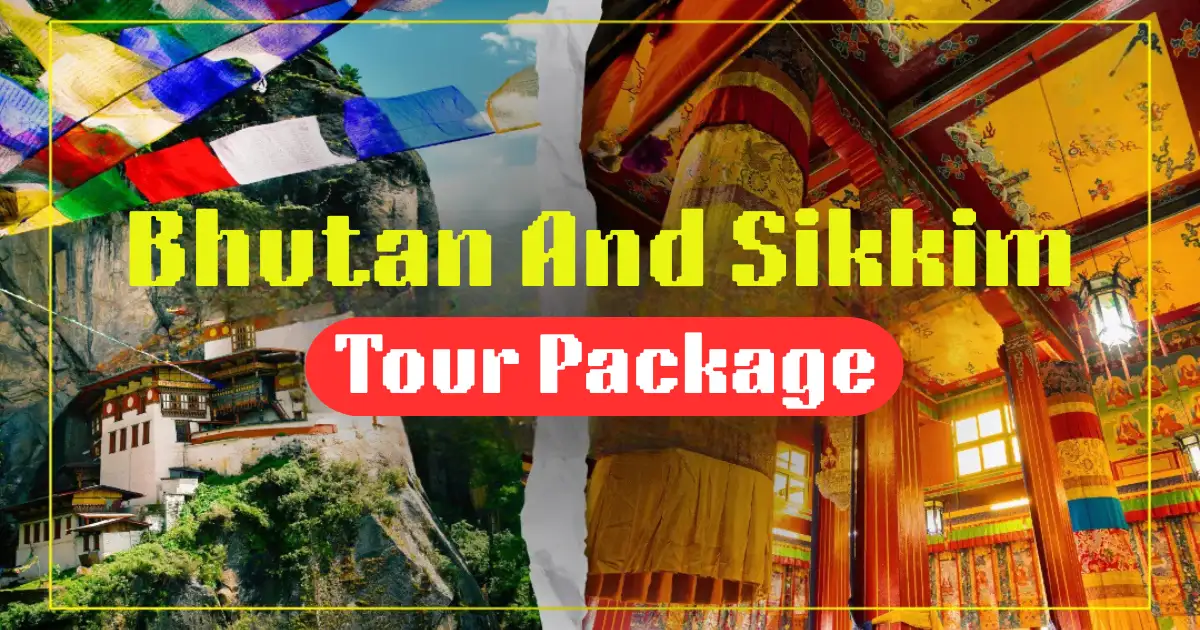
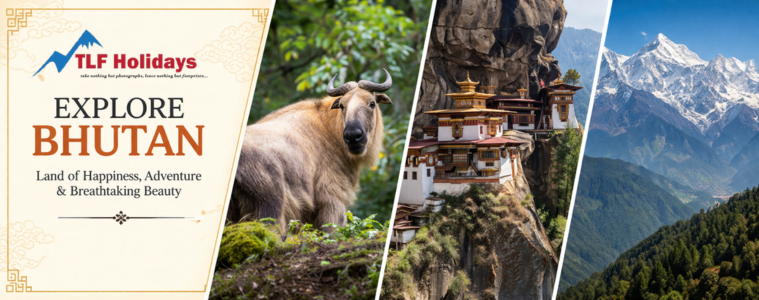
Bhutan is the world’s only carbon-negative country and one of the very last nations to have opened its doors to mass tourism and even then, only in a controlled, high-value manner. The country’s Sustainable Development Fee (SDF), charged at USD 100 per person per night (revised to USD 100 from September 2023 after a period of USD 200), ensures that only thoughtful, committed travellers make the journey. The result is a destination of extraordinary authenticity. Taktshang Monastery the famous Tiger’s Nest hangs at 3,120 metres above Paro Valley, but even without iconic landmarks, Bhutan would captivate: its farmhouses are painted with folk motifs, its roads wind through dark conifer forests, and its people carry a quiet sense of purpose that is deeply affecting.
Those wondering about how to travel from India to Bhutan will be reassured to know that Indian nationals have one of the simplest entry processes: no visa is required, only a permit obtained at the border or through a registered tour operator. The overland route via Phuentsholing (from West Bengal) is popular and scenic.
Sikkim: India’s Himalayan Crown Jewel
Sikkim was an independent monarchy until 1975 when it became India’s 22nd state. That independent spirit is still palpable everywhere. Gangtok, the capital, tumbles down a ridge above the Teesta River with a cosmopolitan energy that surprises first-time visitors. North Sikkim is raw and high-altitude, home to Gurudongmar Lake one of the highest freshwater lakes in the world at 5,183 metres. West Sikkim hides the ancient Pemayangtse Monastery, one of the most important monasteries in the state. Rumtek, near Gangtok, houses one of the most significant Kagyu Buddhist institutions outside Tibet.
Quick Facts for Travellers
- Sikkim’s Inner Line Permit (ILP) is free for Indian nationals and costs a nominal fee for foreigners.
- Bhutan’s SDF (Sustainable Development Fee) is USD 100/night for international tourists (SAARC nationals pay INR 1,200/night).
- Both destinations have limited ATM infrastructure carry sufficient cash.
- Altitude sickness is a real concern above 3,500 metres; acclimatise gradually.
- Photography near religious sites often requires respectful distance always ask.
Sikkim Bhutan Tour Itinerary (12 Days)
The following Sikkim Bhutan Tour Itinerary represents the most popular and logistically optimal way to combine both destinations in a single trip. This 12-day structure allows sufficient time at each location without feeling rushed, and it follows the natural geographical flow from Sikkim (accessible from Bagdogra/NJP) to Bhutan (exiting via Paro or entering via Phuentsholing).
Day1:- Arrival in Bagdogra / Transfer to Gangtok
Fly into Bagdogra Airport or arrive at New Jalpaiguri (NJP) Railway Station. Collect your Inner Line Permit (ILP) and drive approximately 4–5 hours to Gangtok through the lush Teesta Valley. Check in, rest, and take an evening stroll along MG Marg Gangtok’s charming pedestrian promenade.
Day2:- Gangtok Sightseeing
Visit Rumtek Monastery, the Namgyal Institute of Tibetology, Enchey Monastery, and the Flower Exhibition Centre. The iconic Kanchenjunga viewpoint at Gangtok Viewpoint offers a panorama that few mountain vistas can rival.
Day3:- Tsomgo Lake & Nathula Pass Excursion
Drive up to Tsomgo (Changu) Lake at 3,753 metres a sacred glacial lake that shimmers turquoise in summer. Continue to Nathula Pass (4,310 m) on the India-China border. This excursion requires a separate Protected Area Permit, bookable in Gangtok.
Day4:- North Sikkim — Lachung
Drive north to Lachung through Chungthang and Singhik viewpoint. The waterfalls along this route especially Seven Sisters Falls are spectacular. Lachung is a charming village surrounded by apple orchards and pine forests, gateway to Yumthang Valley.
Day5:- Yumthang Valley & Zero Point
Early morning drive to Zero Point (4,800 m) through the stunning Yumthang Valley often called the Valley of Flowers due to its spectacular rhododendron blooms in spring. Return to Lachung, then drive back to Gangtok.
Day6:- Gangtok to Phuentsholing (Bhutan Border)
Drive from Gangtok to Phuentsholing the gateway town on the Bhutan-India border. Complete Bhutan entry formalities (Indian nationals collect a permit here; foreign nationals should pre-arrange a visa through a licensed operator like TLF Holidays Bhutan). Overnight in Phuentsholing.
Day7:- Phuentsholing to Thimphu
Drive from Phuentsholing to Thimphu, Bhutan’s capital, through hairpin bends and the dramatic Chukha Gorge. Visit Buddha Dordenma (the 51.5-metre golden Buddha statue), Tashichho Dzong, and the National Memorial Chorten. Evening at leisure on Thimphu’s lively clock-tower square.
Day8:- Thimphu Exploration
Explore the Folk Heritage Museum, Textile Museum, Takin Preserve (Bhutan’s national animal), Simply Bhutan (a living museum), and local craft shops. Thimphu is the only capital in the world without a traffic light its traffic policemen are a celebrated sight.
Day9:- Thimphu to Punakha via Dochula Pass
Drive over the magnificent Dochula Pass (3,150 m) with its 108 memorial chortens and, on clear days, a view of the high Himalayas. Descend to the subtropical Punakha Valley. Visit Punakha Dzong the most beautiful fortress in Bhutan, sitting at the confluence of two rivers and the Chimi Lhakhang fertility temple.
Day10:- Punakha to Paro
Drive back over Dochula Pass to Paro Bhutan’s most scenic valley, home to its only international airport. Visit Rinpung Dzong and the National Museum of Bhutan. The Paro Valley’s paddy fields, willows, and whitewashed farmhouses embody the classic Bhutanese countryside.
Day11:- Tiger’s Nest (Taktshang) Hike
This is the day every visitor to Bhutan lives for. The hike to Taktshang Monastery (Tiger’s Nest) takes 2–3 hours one way through rhododendron forest. The monastery, perched at 3,120 metres above Paro Valley, was built in 1692 at the cave where Guru Rinpoche meditated in the 8th century. Afternoon at leisure or optional Kyichu Lhakhang visit.
Day12:- Departure from Paro
Final morning at leisure in Paro. Transfer to Paro International Airport for departure. Many travellers extend their stay by a day or two to explore Haa Valley or Chelela Pass the highest motorable pass in Bhutan.
Top Attractions & Experiences
No Bhutan and Sikkim tour package is complete without an understanding of each destination’s landmark experiences. The table below captures the essential attractions across both destinations, along with entry details and what to expect.
Top Attractions — Bhutan & Sikkim
| Attraction | Location | Type | Highlight |
|---|---|---|---|
| Taktshang (Tiger’s Nest) | Paro, Bhutan | Monastery / Trek | Cliffside monastery 900m above valley floor |
| Punakha Dzong | Punakha, Bhutan | Fortress / Architecture | Most ornate dzong; river confluence setting |
| Buddha Dordenma | Thimphu, Bhutan | Statue / Viewpoint | 51.5 m golden Buddha overlooking Thimphu |
| Dochula Pass | Thimphu–Punakha, Bhutan | Mountain Pass | 108 chortens + Himalayan panorama |
| Kanchenjunga Viewpoint | Gangtok, Sikkim | Viewpoint | World’s 3rd highest peak at sunrise |
| Tsomgo (Changu) Lake | East Sikkim | Glacial Lake | Sacred lake at 3,753 m; yak rides available |
| Rumtek Monastery | Gangtok, Sikkim | Monastery | Seat of Kagyu lineage; rich thangkas & relics |
| Yumthang Valley | North Sikkim | Valley / Nature | “Valley of Flowers”; rhododendron carpets |
| Nathula Pass | East Sikkim | Mountain Pass | India-China border post at 4,310 m |
| Pemayangtse Monastery | West Sikkim | Monastery | 17th-century royal monastery; remarkable murals |
| Kyichu Lhakhang | Paro, Bhutan | Temple | One of Bhutan’s oldest temples, 7th century |
| MG Marg, Gangtok | Gangtok, Sikkim | Promenade | Pedestrian-only hub of Gangtok’s social life |
Best Time to Visit Bhutan and Sikkim
Timing a Bhutan Sikkim Tour correctly can make the difference between a memorable and a merely average experience. Both destinations have distinct seasonal personalities that suit different types of travellers.
Spring (March–May) — The Bloom Season
This is widely considered the best season for a Bhutan and Sikkim tour package. In Bhutan, the valleys burst into colour with cherry blossoms, magnolias, and jacaranda. Paro’s famous Tsechu festival typically falls in spring, drawing monks in elaborate masks and costumes for a week-long celebration. In Sikkim, the rhododendron forests of Yumthang Valley reach their peak bloom in April — a natural spectacle of extraordinary beauty. Skies are generally clear, temperatures are pleasant, and mountain views are at their crispest.
Autumn (September–November) — The Classic Season
Post-monsoon clarity makes October and November the second-best window for this tour. The air is washed clean after the rains, Himalayan peaks are sharply visible, and the countryside in both Bhutan and Sikkim takes on a warm golden hue as harvests come in. Bhutan’s Thimphu Tsechu falls in September or October another major festival not to miss.
Winter (December–February) — The Quiet Season
Winter brings cold temperatures and snow at higher altitudes, but both Gangtok and Thimphu remain accessible. Crowds are minimal, accommodation costs are lower, and there is an ethereal stillness to the landscape. Punakha Dzong, surrounded by mustard fields in bloom, is at its most photogenic in January and February. North Sikkim and high-altitude passes may be inaccessible.
Monsoon (June–August) — The Lush Season
The monsoon brings heavy rainfall, landslides, and leeches to both regions, making travel challenging particularly in Sikkim’s north. However, for those who don’t mind the rain, the landscapes are intensely green, waterfalls are at full power, and tourist crowds are virtually absent. Bhutan’s western valleys receive less rain than Sikkim, making Thimphu and Paro relatively more manageable in monsoon.
Month-by-Month Travel Guide — Bhutan & Sikkim
| Month | Weather | Bhutan Suitability | Sikkim Suitability | Special Events |
|---|---|---|---|---|
| January | Cold, dry | ⭐⭐⭐ | ⭐⭐⭐ | Punakha Drubchen |
| February | Cold, clear | ⭐⭐⭐⭐ | ⭐⭐⭐ | Paro Festival begins |
| March | Mild, blooms begin | ⭐⭐⭐⭐⭐ | ⭐⭐⭐⭐ | Paro Tsechu |
| April | Warm, blossoms peak | ⭐⭐⭐⭐⭐ | ⭐⭐⭐⭐⭐ | Rhododendron season, Sikkim |
| May | Warm, pre-monsoon | ⭐⭐⭐⭐ | ⭐⭐⭐⭐ | Buddha Purnima |
| June | Monsoon begins | ⭐⭐ | ⭐⭐ | — |
| July | Heavy rain | ⭐⭐ | ⭐ | — |
| August | Heavy rain | ⭐⭐ | ⭐ | — |
| September | Rain tapering | ⭐⭐⭐ | ⭐⭐⭐ | Thimphu Tsechu |
| October | Clear, golden | ⭐⭐⭐⭐⭐ | ⭐⭐⭐⭐⭐ | Dashain, Tihar (Sikkim) |
| November | Cool, crystal clear | ⭐⭐⭐⭐⭐ | ⭐⭐⭐⭐ | Jambay Lhakhang Drup (Bhutan) |
| December | Cold, dry | ⭐⭐⭐ | ⭐⭐⭐ | Black-necked Crane Festival |
Tour Package Cost & Budget Breakdown
One of the most common questions from prospective travellers concerns whether Is Bhutan Expensive. The honest answer: Bhutan is deliberately expensive for international tourists, but this cost comes with significant value and is entirely worth the investment. Sikkim, as part of India, is far more budget-accessible. The combination, particularly when booked as a comprehensive Bhutan and Sikkim tour package, typically works out more economical than booking the two legs separately.
Bhutan Costs (Per Person, International Tourists)
International tourists are required to pay the Sustainable Development Fee (SDF) of USD 100 per person per night. This is separate from the cost of accommodation, meals, and guide. Most tour operators offer all-inclusive packages that bundle SDF, accommodation, licensed guide, transport, and meals. A typical 5-night Bhutan component within a combo package costs between USD 800–1,500 per person depending on accommodation category. Indian, Bangladeshi, and Maldivian nationals enjoy concessionary rates (INR 1,200/night SDF) and no visa fees, making the Bhutan and Sikkim tour package particularly accessible for Indian travellers. For those already exploring Southeast Asia, combining with a Bhutan tour package from Bangkok is also an increasingly popular option through operators offering multi-country Himalayan itineraries.
Sikkim Costs (Per Person, Indian Nationals)
Sikkim is very affordable. A comfortable 5-night Sikkim itinerary with a decent hotel, private transfers, and sightseeing can cost between INR 15,000–30,000 per person. Foreign nationals pay slightly more due to permit and guide requirements. North Sikkim excursions to Yumthang and Zero Point add another INR 2,500–4,000 per person for the permit and shared vehicle costs.
Estimated Cost Breakdown for 12-Day Bhutan and Sikkim Tour Package
| Component | Budget Tier (INR) | Mid-Range (INR) | Luxury (INR) |
|---|---|---|---|
| Bhutan — Accommodation (6 nights) | 18,000–25,000 | 30,000–55,000 | 80,000–1,50,000+ |
| Bhutan — SDF (SAARC: INR 1,200/night) | 7,200 | 7,200 | 7,200 |
| Bhutan — Meals (all inclusive pkg) | Included | Included | Included |
| Bhutan — Guide & Transport | Included in pkg | Included in pkg | Included in pkg |
| Sikkim — Accommodation (5 nights) | 8,000–12,000 | 15,000–25,000 | 35,000–70,000 |
| Sikkim — Transport & Sightseeing | 5,000–8,000 | 10,000–15,000 | 20,000–35,000 |
| Sikkim — Permits (ILP + N. Sikkim) | 500–800 | 500–800 | 500–800 |
| Meals — Sikkim | 2,000–4,000 | 5,000–9,000 | 12,000–25,000 |
| Flights (Bagdogra arrival + Paro exit) | 12,000–18,000 | 18,000–30,000 | 40,000–80,000 |
| Approximate Total (Per Person) | ₹52,700–74,800 | ₹85,700–1,41,800 | ₹1,94,700–3,68,000+ |
Note: Costs are approximate as of early 2025 and vary by operator, season, and group size. International tourists should add USD 100/night SDF for Bhutan on top of the above figures. Contact TLF Holidays Bhutan for exact current pricing and customised packages.
Travel Tips & Practical Information
Permits and Documentation
Both destinations require permits beyond the standard passport/visa. For Bhutan, Indian nationals need a permit obtainable at the border (Phuentsholing, Gelephu, or Samdrup Jongkhar) with a valid passport or voter ID. Foreign nationals require a visa arranged through a licensed Bhutanese tour operator which must also arrange and pay the SDF. For Sikkim, all visitors need an Inner Line Permit (ILP), available at Rangpo (road entry) or Bagdogra Airport. North Sikkim, Nathula Pass, and certain restricted zones require additional Protected Area Permits (PAP) that must be applied for in Gangtok with a registered operator.
Getting Around
Within Bhutan, all tourists must travel with a licensed guide in a pre-arranged vehicle. Self-driving and independent travel are not permitted. In Sikkim, private taxis and shared jeeps are the main forms of transport. For the Sikkim-to-Bhutan leg, most travellers drive from Gangtok to Siliguri/NJP and then proceed to Phuentsholing a journey of about 5–6 hours, or fly Bagdogra to Paro with Druk Air or Bhutan Airlines.
Health and Altitude
Altitude is a serious consideration on this tour. Tsomgo Lake (3,753 m), Zero Point (4,800 m), Dochula Pass (3,150 m), and Tiger’s Nest (3,120 m) all require physical fitness and slow acclimatisation. Drink plenty of water, avoid alcohol on the first day at high altitude, and keep Diamox (acetazolamide) on hand after consulting your doctor. Travel insurance covering high-altitude trekking is strongly recommended.
Packing Essentials
Layers are essential in both destinations, even in summer. Pack moisture-wicking base layers, a fleece mid-layer, and a waterproof outer shell. A sun hat, sunscreen (SPF 50+), and UV-protection sunglasses are crucial at altitude. Comfortable trekking shoes are essential for the Tiger’s Nest hike and Sikkim’s mountain trails. A personal first-aid kit including altitude medication, oral rehydration salts, and blister plasters is advisable.
Responsible Tourism
Both Bhutan and Sikkim are environmentally sensitive destinations with strong conservation commitments. Bhutan’s constitution mandates that at least 60% of land remains forested in perpetuity a commitment that has been consistently exceeded (currently above 71%). Visitors should carry reusable water bottles, avoid single-use plastics, and respect local customs around religious sites. Photography of religious rituals should always be done with permission and never with flash inside monasteries.
Booking Your Bhutan and Sikkim Tour Package
- Book at least 60–90 days in advance for peak season (March–May, October–November).
- Bhutan visas require a confirmed booking with a licensed operator before application.
- TLF Holidays Bhutan offers fully customised Bhutan and Sikkim combo packages including permits, accommodation, guides, and transport.
- Group bookings (6+ persons) often receive significant discounts, especially for Bhutan packages.
- Travel insurance is mandatory for all Bhutan visa applications.
Conclusion
A Bhutan and Sikkim tour package is not just a holiday it is an immersion in two of the world’s most spiritually rich and visually spectacular Himalayan cultures. From the ancient monasteries of Rumtek and Pemayangtse to the cliffside wonder of Tiger’s Nest; from the crystal waters of Tsomgo Lake to the golden glow of Punakha Dzong reflected in the Pho Chhu River every moment of a Bhutan Sikkim Tour reframes your understanding of what travel can mean.
Whether you follow the 12-day Sikkim Bhutan Tour Itinerary outlined in this guide or tailor a bespoke journey with the help of experienced operators like TLF Holidays Bhutan, the combination of these two extraordinary destinations will remain with you long after you return home. Plan early, pack thoughtfully, and travel with an open heart the Himalayas will do the rest. Plan Your Trip with TLF Holidays Bhutan
FAQs
Q1. What is the ideal duration for a Bhutan and Sikkim tour package?
A 10–14 day itinerary is ideal, with 5–6 days each in Sikkim and Bhutan to experience the highlights without feeling rushed.
Q2. Do Indian nationals need a visa for Bhutan?
No, Indian nationals do not require a visa; they need only a valid passport or voter ID and obtain a free entry permit at the border.
Q3. How to travel from India to Bhutan?
Indian travellers can enter Bhutan by road via Phuentsholing (from West Bengal), Gelephu (from Assam), or by air via Paro International Airport on Druk Air or Bhutan Airlines.
Q4. Is Bhutan expensive for Indian tourists?
Bhutan is moderately priced for Indian tourists who pay a concessionary SDF of INR 1,200 per night (vs USD 100 for other nationals), making it significantly more affordable than for Western travellers.
Q5. What is the best time to visit for a Bhutan and Sikkim tour?
March–May (spring, rhododendron season) and October–November (post-monsoon clarity) are the two best seasons for this combined tour.
Q6. Can I book a Bhutan tour package from Bangkok?
Yes, several operators including TLF Holidays Bhutan offer Bhutan tour packages from Bangkok with Druk Air flying directly from Bangkok (BKK) to Paro.
Q7. Is the Tiger’s Nest hike difficult?
The hike is moderate in difficulty — approximately 5–6 hours return — and is manageable for reasonably fit travellers with proper footwear and a slow pace.
Q8. What permits are required for a Sikkim Bhutan tour itinerary?
Travellers need Sikkim’s Inner Line Permit (ILP), a Protected Area Permit for North Sikkim and Nathula, and a Bhutan entry permit (visa for foreign nationals, free permit for Indians).
Q9. What is the best entry point for a Bhutan and Sikkim combo tour?
Fly into Bagdogra Airport or arrive at NJP to start with Sikkim, then proceed to Bhutan via Phuentsholing (overland) or fly Bagdogra–Paro.
Q10. Can solo travellers book a Bhutan and Sikkim tour package?
Yes, solo travellers can book these packages; however, Bhutan requires travel with a licensed guide, and solo travel is perfectly safe in Sikkim as well.
Q11. Is altitude sickness a concern on this tour?
Yes, particularly at North Sikkim’s Zero Point (4,800 m) and Nathula Pass (4,310 m); acclimatise gradually, stay hydrated, and consult a doctor about Diamox before travel.
Q12. Why should I book with TLF Holidays Bhutan for this tour?
TLF Holidays Bhutan is a licensed Bhutanese tour operator with deep expertise in cross-border Bhutan–Sikkim packages, handling all permits, accommodation, and logistics seamlessly.

Comments (21)
Alivia1053,
04 April, 2026https://shorturl.fm/jwGGq
Summer4206,
05 May, 2026https://shorturl.fm/s8lUe
Imelda3801,
07 July, 2026https://shorturl.fm/aX692
Anastasia1629,
07 July, 2026https://shorturl.fm/HMjlw
London624,
07 July, 2026https://shorturl.fm/RmBwH
Gertrude515,
07 July, 2026https://shorturl.fm/yMMIQ
Cale1395,
07 July, 2026https://shorturl.fm/Ks94E
Nigel2692,
07 July, 2026https://shorturl.fm/VoDWX
Elizabeth1184,
07 July, 2026https://shorturl.fm/qIki9
Callie3836,
07 July, 2026https://shorturl.fm/0YdHF
Joshua994,
07 July, 2026https://shorturl.fm/lu7t8
Chris2041,
08 August, 2026https://shorturl.fm/ZK7cB
Khloe1078,
08 August, 2026https://shorturl.fm/ek69i
Marian2506,
08 August, 2026https://shorturl.fm/Hlt5z
Brandi4374,
08 August, 2026https://shorturl.fm/MQNIh
ck888game,
09 September, 2026Top notch graphics and really engaging gameplay. It is honestly one of the best gaming experiences I have had in a long time. Big thanks to ck888game
br888win9,
09 September, 2026The game variety is insane and I love the daily bonuses. It really keeps things exciting. Highly recommend br888win9 to anyone looking for a reliable spot.
idimbagacor,
09 September, 2026Honestly the win rates here are impressive. I had a lucky streak yesterday that I cannot believe. If you want a fair game visit idimbagacor
br4444win,
09 September, 2026Just had my first big win here and the withdrawal was processed almost instantly. Such a breeze. Go try br4444win!
bd89bat,
09 September, 2026Really impressed with the customer support and the overall vibe of the site. Everything feels professional at bd89bat.
zs88com,
09 September, 2026I appreciate the transparency of this site. No hidden fees and the withdrawal process is straightforward. It is a reliable choice for anyone. zs88com